Will AI Replace Business Websites—or Make Them More Important?
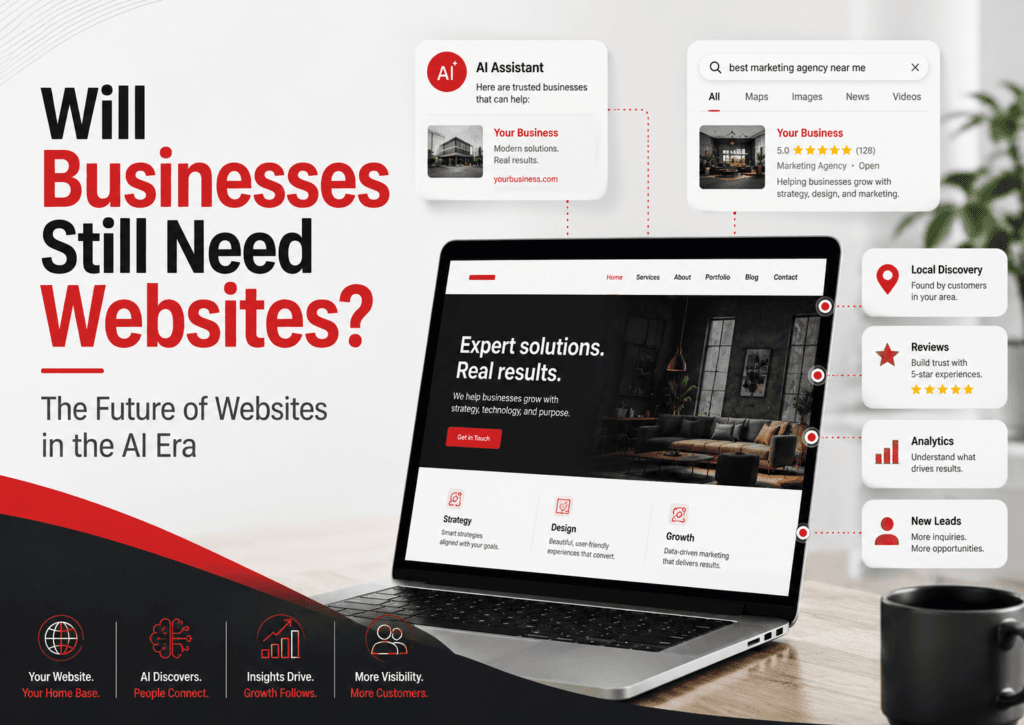
With artificial intelligence answering questions directly, social media platforms functioning like digital storefronts, and Google displaying more information without requiring a website visit, many business owners are beginning to ask an understandable question:
Will businesses still need websites in the future?
The honest answer is yes—but simply having a website will no longer be enough.
Business websites are not disappearing. Their role is changing.
In the past, a website was often the starting point for discovering a company. Today, customers may first encounter a business through Google Maps, an AI-generated answer, a social media post, an online review, YouTube, ChatGPT, Microsoft Copilot, or another digital platform.
The website is increasingly the place where people—and AI systems—verify whether a business is legitimate, experienced, trustworthy, and capable of meeting their needs.
The website of the future will be more than an online brochure. It will serve as the business’s official information source, trust center, content library, conversion platform, and foundation for visibility across search engines and AI assistants.
Why Business Owners Are Questioning the Need for Websites
It is easy to understand why some business owners wonder whether a website is still necessary.
Customers can now find business hours, directions, reviews, photos, services, and contact information through a Google Business Profile. Some businesses receive leads almost entirely through Facebook, Instagram, LinkedIn, TikTok, or online marketplaces.
AI platforms can also answer questions that previously required someone to visit several websites.
For example, a homeowner might ask an AI assistant:
- What should I expect during a kitchen remodel?
- How much does a website redesign cost?
- What type of therapist helps with grief?
- How do I choose a fundraising auction company?
- Which local businesses provide a particular service?
The AI system may summarize information, compare options, and provide recommendations without requiring the user to visit every source.
Research from Pew Research Center demonstrates how this behavior can affect website traffic. In its analysis of Google searches, users who encountered an AI-generated summary clicked a traditional search result during 8% of visits. When an AI summary did not appear, users clicked a search result during 15% of visits.
This does not mean websites are becoming irrelevant. It means fewer people may visit a website merely to obtain a simple answer.
The people who do visit may be further along in their decision-making process.
AI May Reduce Some Website Traffic
Businesses should prepare for the possibility that informational website traffic will decline.
A customer may no longer need to visit a restaurant’s website to see its hours. They may not need to open a contractor’s blog to receive a basic explanation of remodeling costs. They may not click through to a marketing company’s article just to learn the definition of local SEO.
AI-generated results can provide those answers immediately.
However, website traffic has never been the ultimate goal for most small businesses. The real goal is generating qualified leads, appointments, calls, purchases, donations, registrations, or other meaningful actions.
A business could lose some low-intent visitors while still attracting better-qualified prospects.
Someone asking, “What is kitchen remodeling?” may remain in an AI result.
Someone seriously considering a $40,000 remodeling project will probably still want to see the contractor’s portfolio, service area, process, credentials, reviews, warranties, and completed projects.
AI may answer the first question, but the business website helps close the sale.
Why Small Businesses Will Still Need Websites
A Website Is a Digital Property You Control
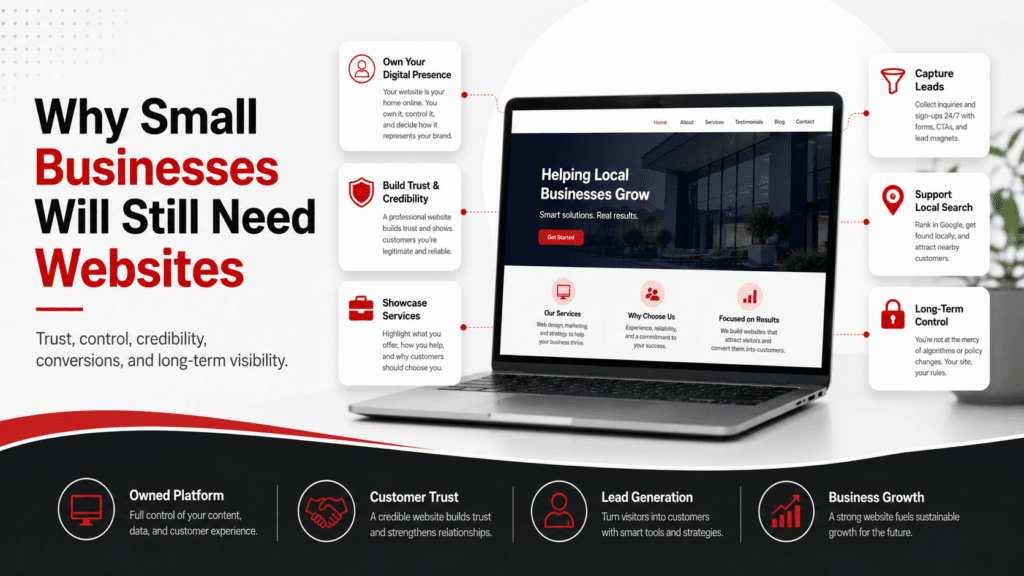
Social media profiles, marketplace listings, and business directories are valuable, but the business does not own those platforms.
A platform can change its algorithm, reduce organic reach, suspend an account, introduce additional fees, restrict content, or discontinue a feature. A business that depends entirely on another company’s platform is building its online presence on rented property.
Your website is the digital property over which you have the greatest control.
You determine:
- How the business is presented
- What information appears
- Which services receive priority
- How leads are collected
- What calls to action visitors see
- How customer information is handled
- Which content is published
- How the brand experience is designed
Social media, Google Business Profile, email marketing, online directories, and AI search should help people discover the business. The website gives that discovery a stable destination.
A Website Helps Establish Legitimacy
Prospective customers often investigate a business before contacting it, especially when the purchase involves significant money, personal information, access to a home, or a long-term professional relationship.
They may review:
- The company’s history
- Team member qualifications
- Service descriptions
- Project galleries
- Case studies
- Testimonials
- Professional affiliations
- Frequently asked questions
- Privacy and business policies
- Contact information
A poorly maintained website can create doubt. A professional, up-to-date, helpful website reassures visitors that the company is active and takes its business seriously.
For local companies in Frisco, Plano, Allen, McKinney, Celina, and surrounding North Texas communities, a website can also demonstrate genuine local knowledge rather than merely claiming to serve an area.
A Website Converts Interest Into Action
AI assistants, search engines, reviews, and social media may introduce the business, but customers still need a reliable way to take the next step.
A website can provide:
- Estimate request forms
- Appointment scheduling
- Online payments
- Ecommerce
- Event registration
- Donations
- Newsletter subscriptions
- Downloadable resources
- Secure customer portals
- Click-to-call buttons
- Location and service-area information
The website connects visibility to measurable business outcomes.
Websites Are Becoming Information Sources for AI
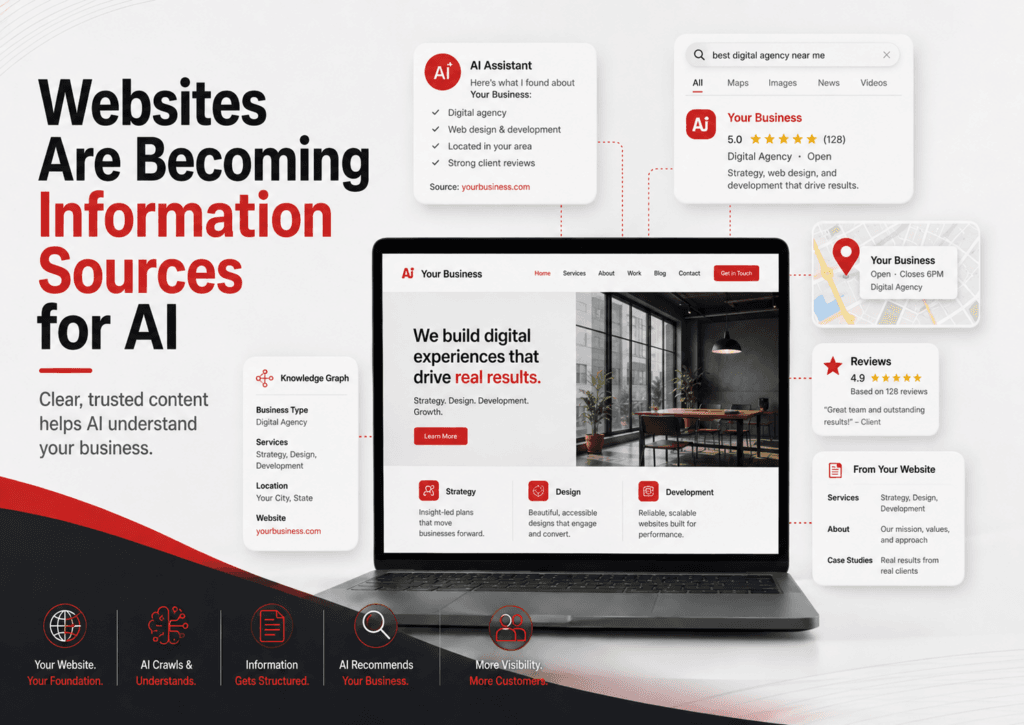
One of the most important changes is that a website is no longer written only for human visitors and traditional search engines.
This shift is a major part of AI visibility for small businesses, because AI platforms need clear, credible, and well-structured website content to understand and potentially recommend a company.
It can also help AI platforms understand the business.
An effective website clearly communicates:
- Who the company is
- What services it provides
- Where it operates
- Who it serves
- What makes it qualified
- What customers frequently ask
- What experience supports its claims
- How someone can contact or hire the company
Google has published specific guidance for helping websites appear in AI Overviews and AI Mode. According to Google, the same foundational SEO practices that support traditional search remain relevant to generative AI search, including a clear technical structure and unique, helpful, reliable content.
Google also states that its generative search features can include information about local businesses and that Google Business Profiles can help products and services become visible within AI responses and other search results.
Microsoft is moving in the same direction. Bing Webmaster Tools introduced an AI Performance dashboard that reports when a website is cited in AI-generated answers across Microsoft Copilot experiences. It can show total citations, cited pages, and the phrases associated with those citations.
OpenAI’s ChatGPT search also provides timely answers with links to relevant web sources.
These developments make one point clear: AI systems still need credible information sources.
A business that has no website—or has a thin, outdated, unclear website—provides AI systems with less reliable information to understand, verify, and potentially reference.
The Basic Brochure Website Is Losing Value
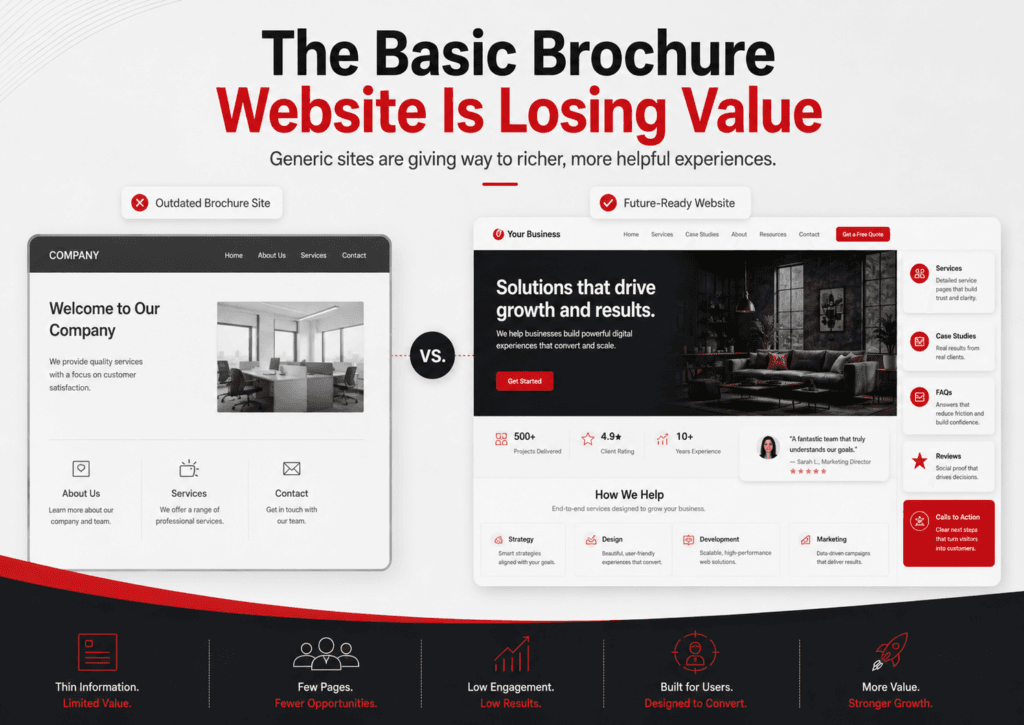
Websites will remain important, but not every website will remain equally valuable.
The traditional five-page brochure website typically includes a homepage, a short About page, a general Services page, a gallery, and a Contact page.
That may no longer provide enough information for customers, search engines, or AI platforms.
Generic statements such as “We provide high-quality service and care about our customers” do little to distinguish one company from another.
The future belongs to websites that contain substance.
That includes:
- Detailed service information
- Original project examples
- First-hand experience
- Genuine customer questions
- Helpful explanations
- Specific service areas
- Clear credentials
- Accurate business information
- Case studies and results
- Transparent processes
- Current photos and videos
- Strong calls to action
A website should demonstrate why the business deserves attention rather than simply announce its existence.
What the Future Small-Business Website Will Need
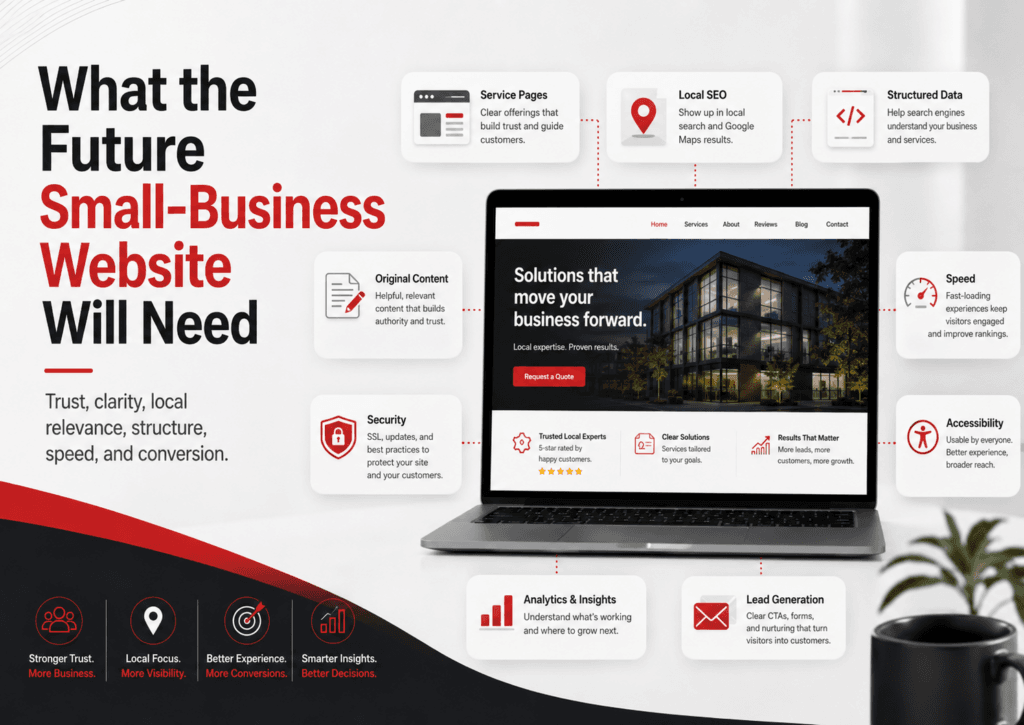
Detailed Service Pages
Each important service should have a useful page explaining what it includes, who it is for, how the process works, and what customers should expect.
A single page listing ten services in a few sentences may not provide enough depth.
Original, Experience-Based Content
AI can generate generic explanations quickly. That makes genuine experience more valuable.
Businesses should publish information that cannot be reproduced simply by asking an AI tool for a general answer, such as:
- Lessons from completed projects
- Before-and-after examples
- Local considerations
- Common customer mistakes
- Professional recommendations
- Real-world outcomes
- Original photographs
- Frequently encountered problems
Google recommends creating non-commodity, expert-led content that provides value beyond common knowledge.
Strong Local Information
A local business website should make its geographic relevance clear.
That does not mean creating dozens of nearly identical city pages. It means explaining where the business operates and demonstrating meaningful knowledge of those communities.
A remodeling company serving Plano may discuss housing styles, permitting considerations, older neighborhoods, and common remodeling priorities in that area.
A marketing company serving Frisco and Collin County may discuss the competition local businesses face in Google Maps, local search results, reviews, and AI-generated recommendations.
Structured Data and Consistent Business Information
Structured data helps search engines understand information about the organization, services, articles, people, events, products, and frequently asked questions.
The website’s name, address, phone number, service information, hours, and other important details should also remain consistent with Google Business Profile and other reputable online listings.
Structured data is not a shortcut to rankings or AI citations, but it can help systems interpret the website more accurately.
Security, Speed, Accessibility, and Maintenance
A future-ready website must also function properly.
That includes:
- Current software
- Secure hosting
- Regular backups
- Vulnerability monitoring
- Mobile usability
- Fast loading
- Accessible navigation and content
- Working forms
- Accurate links
- Reliable analytics
A website that is outdated, insecure, inaccessible, or difficult to use can damage trust regardless of how attractive it looks.
Ongoing professional WordPress maintenance helps keep your website secure, up to date, accessible, and reliable as technology and search expectations continue to evolve.
Can Social Media Replace a Website?
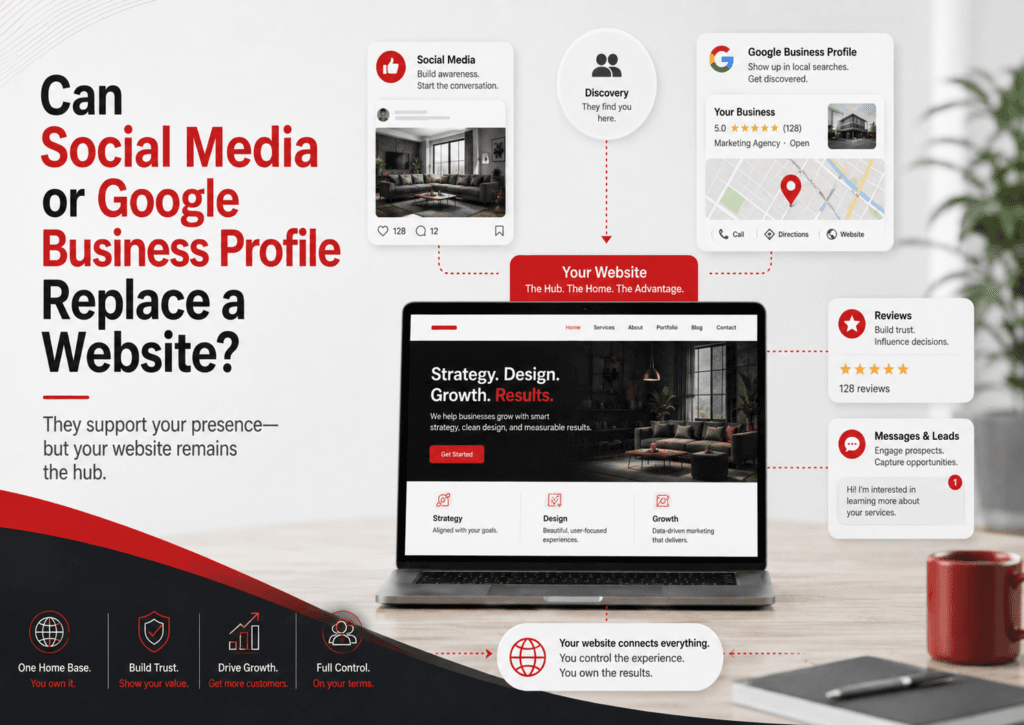
Social media can support a website, but it rarely replaces everything a website provides.
Social platforms are excellent for:
- Building awareness
- Sharing photos and videos
- Starting conversations
- Promoting events
- Reaching existing followers
- Demonstrating personality
However, posts quickly disappear from view, and older information can be difficult to organize or find.
A website gives the business a permanent, searchable structure for services, case studies, resources, policies, and conversion opportunities.
The strongest strategy is not choosing between a website and social media. It is using social media to attract interest and the website to provide depth, trust, and a clear next step.
Can a Google Business Profile Replace a Website?
A Google Business Profile is essential for many local businesses, but it should not normally be the company’s entire online presence.
Google Business Profile can display hours, reviews, photos, updates, directions, and contact options. However, Google controls the profile, its features, and how prominently it appears.
A website allows the business to explain services in greater detail, publish original content, feature projects, collect leads, and control the customer journey.
The website and Google Business Profile should reinforce each other rather than compete.
How Small Businesses Should Prepare Now
Businesses do not need to rebuild their entire digital presence as AI search grows. They should begin strengthening the assets they already have.
A practical starting point is to:
- Review whether every important service has adequate information.
- Update outdated business details, team information, photos, and policies.
- Add answers to real customer questions.
- Publish original examples, projects, case studies, and insights.
- Confirm that Google and Bing can crawl and index the website.
- Validate relevant structured data.
- Keep Google Business Profile information accurate.
- Improve mobile usability, speed, security, and accessibility.
- Strengthen calls to action and lead tracking.
- Begin monitoring whether the company appears in AI-generated answers.
The goal is not to chase every new AI visibility tactic.
The goal is to create the clearest, most useful, most trustworthy source of information about the business.
Frequently Asked Questions
Will AI eventually replace business websites?
AI may replace some website visits, particularly when users want simple facts or general explanations. It is less likely to replace the need for businesses to provide an official, controlled source of detailed information, proof, services, and conversion options.
Will small businesses still need websites in five years?
Most established small businesses will continue to benefit from having a professional website. The website may receive traffic from a wider range of sources, including search engines, AI assistants, social media, email, maps, online directories, and referrals.
Is SEO still worth investing in?
Yes, but SEO is expanding beyond traditional rankings and blue links. Businesses must consider technical search visibility, local search, Google Maps, helpful content, structured data, brand authority, and whether content can be understood and cited by AI systems.
Google continues to state that foundational SEO practices remain relevant to its generative AI search features.
How can a website become more visible in AI results?
There is no guaranteed method for earning an AI citation or recommendation. Businesses can improve their chances by publishing clear, accurate, original, experience-based content; maintaining strong technical SEO; providing consistent business information; using appropriate structured data; and establishing credibility across the web.
Do I need a website if most of my customers come from referrals?
A website can still help referred prospects verify the business before making contact. People frequently research a company even after receiving a personal recommendation.
Is a Facebook page enough for a small business?
A Facebook page can be useful, but it does not offer the same level of ownership, flexibility, organization, search visibility, or conversion control as a website. It is better used as part of a larger digital presence.
The Future Is Not Website Versus AI
The future is not a competition between websites and artificial intelligence.
Websites supply the detailed, trustworthy information that customers, search engines, and AI systems need. AI changes how that information is discovered, summarized, and presented.
Some businesses may receive fewer casual website visitors. At the same time, the people who reach the website may be more informed and closer to choosing a provider.
The companies that succeed will not be those that simply keep an old website online. They will be the companies that transform their websites into authoritative, useful, well-maintained resources.
A future-ready website should help:
- Customers understand the business
- Search engines organize its information
- AI systems interpret its expertise
- Prospects evaluate its credibility
- Visitors confidently take the next step
Small businesses will still need websites.
They will simply need websites that do more than exist.
Is Your Website Ready for the Future of Search?
TK Internet Marketing helps local businesses build, maintain, and improve WordPress websites that support customer trust, local SEO, conversions, and emerging AI visibility.
From website design and WordPress maintenance to structured data, content development, Google Business Profile optimization, and AI visibility monitoring, we help businesses build a stronger digital foundation for how customers search today—and how they will search in the future.
Contact TK Internet Marketing to discuss whether your current website is prepared for search engines, AI platforms, and the next generation of customers.
