For many years, small-business digital marketing focused on one primary goal: ranking as high as possible on Google.
Rankings still matter. However, they no longer tell the entire story.
Customers are increasingly asking complete questions rather than typing short keyword phrases. They may turn to Google’s AI Overviews and AI Mode, ChatGPT, Gemini, Microsoft Copilot, voice assistants, or other AI-powered tools for help choosing a company, comparing services, estimating costs, or understanding how a service works.
Instead of reviewing 10 blue links, the customer may receive a summary that draws on information from several sources.
This creates a new challenge for small businesses:
Will the AI system recognize your business, understand what you offer, trust your information, and include you in its answer?
That is the foundation of AI visibility.
What Is AI Visibility?
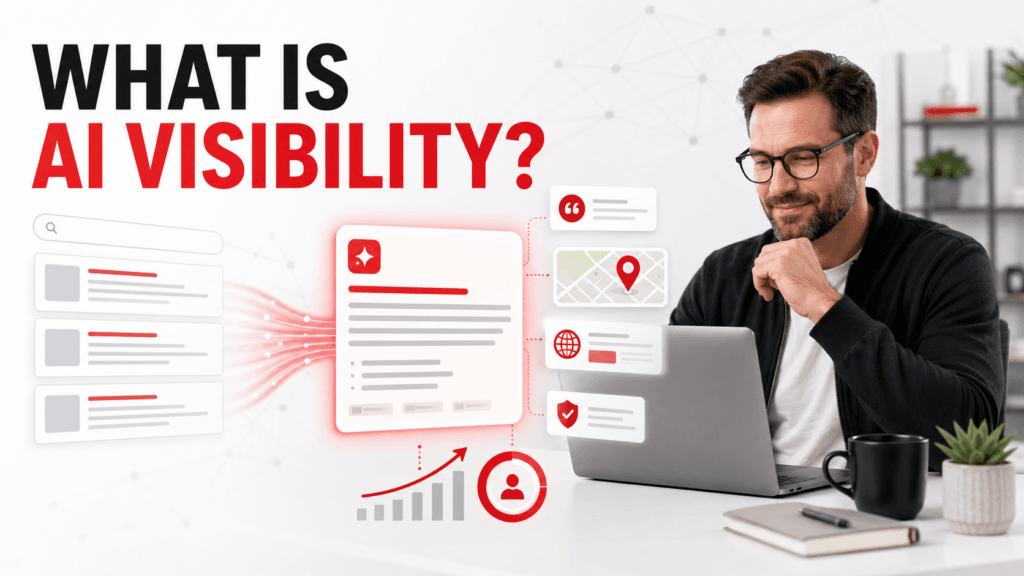
AI visibility is the ability of a business, brand, website, product, service, or expert to be discovered, understood, referenced, cited, or recommended within AI-generated answers.
Traditional search visibility usually asks:
- Does the website rank for an important keyword?
- Is the business listed in Google Maps?
- How many people clicked the search result?
- Did the page move higher or lower in the rankings?
AI visibility introduces additional questions:
- Does the AI system understand what the business does?
- Does it recognize the company’s service area?
- Can it connect the business with a specific customer need?
- Does it view the website as a credible source?
- Is the business mentioned consistently across the web?
- Is its content clear enough to be summarized accurately?
- Could the business be cited or recommended in an AI-generated response?
A company may therefore have meaningful visibility even when it is not the first traditional search result.
For example, a homeowner might ask:
“What should I look for when choosing a remodeling contractor in Plano?”
An AI-generated answer may summarize several selection criteria and provide sources supporting its advice. A remodeling company with detailed service pages, firsthand project examples, helpful articles, customer reviews, accurate business information, and demonstrated local expertise may be more useful to that answer than a website containing only a short sales pitch.
The opportunity is no longer limited to ranking for the exact phrase “remodeling contractor Plano.” The company may also earn visibility when people ask related questions about budgets, timelines, permits, design decisions, storage improvements, kitchen remodeling, or contractor qualifications.
Rankings Still Matter—but the Customer Journey Is Changing
AI visibility does not replace search engine optimization. It expands it.
Google says its generative search features remain connected to its core Search ranking and quality systems. Its guidance recommends continuing to follow foundational SEO practices while publishing unique, useful, people-first content. Google also states that businesses do not need special AI files or unusual markup to qualify for its generative search experiences. Google Search Central: Optimizing for generative AI features
The important change is how people interact with information.
A traditional search might look like this:
“Frisco WordPress designer”
An AI-assisted search may be much more specific:
“Who can redesign a small-business WordPress website in Frisco, improve local SEO, and provide ongoing maintenance after launch?”
That longer question reveals much more about what the customer needs. It may also cause the system to evaluate several kinds of information at once:
- Services
- Location
- Industry experience
- Technical expertise
- Reputation
- Maintenance options
- Relevant educational content
- Evidence supporting the business’s claims
A business may rank well for one short keyword but remain difficult for AI systems to understand. Conversely, a company with a well-organized and authoritative online presence may be discovered across many detailed questions that were never tracked as individual keywords.
AI Visibility Versus Traditional SEO
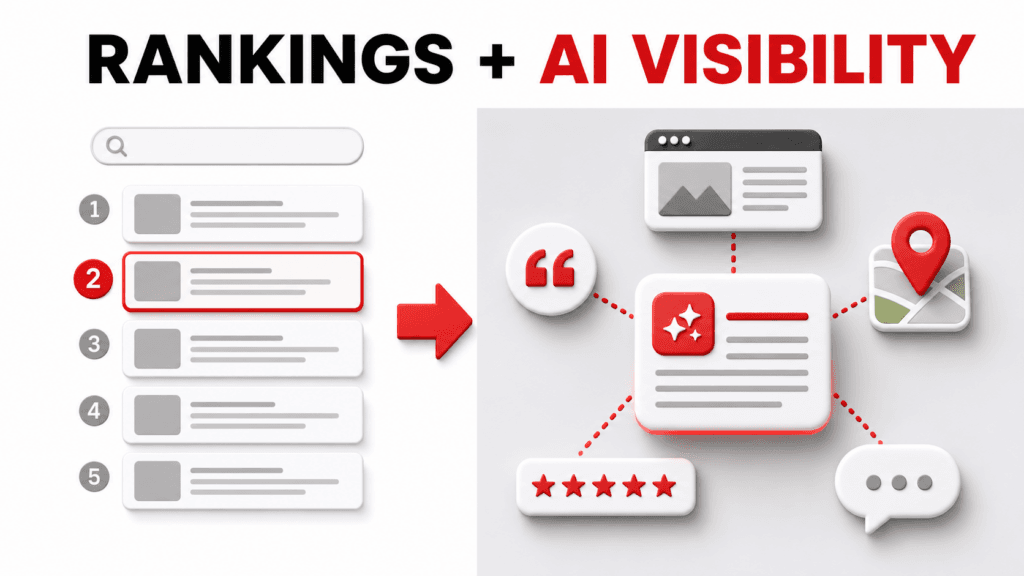
Traditional SEO and AI visibility share many foundations, but they emphasize different outcomes.
| Traditional SEO commonly measures | AI visibility also considers |
|---|---|
| Keyword rankings | Mentions and inclusion in generated answers |
| Organic clicks | Citations and supporting-source appearances |
| Search impressions | Visibility across multiple AI platforms |
| Backlinks | Brand references and corroborating information |
| Page-level performance | Whether the system understands the overall business |
| Search-result position | Relevance to detailed, conversational questions |
| Website traffic | Influence that may occur before a website visit |
A business still needs a technically sound, searchable website. However, it also needs information that machines can interpret and people can trust.
That means AI visibility is not a separate marketing shortcut. It is the result of connecting strong SEO, helpful content, structured business information, local authority, reputation, and firsthand expertise.
Why AI Visibility Matters to Small Businesses
Large companies usually have extensive online footprints. Their brands appear on thousands of pages, news sites, directories, social platforms, review sites, product databases, and industry publications.
Small businesses may have far less information available.
If a company’s website contains only a homepage, a brief services page, and a contact form, an AI system has limited evidence from which to understand the business. It may not know:
- Which services the company specializes in
- Where the company works
- Who owns or operates it
- What experience the team has
- What makes the business different
- Whether its information is current
- Which customer problems it is qualified to solve
This can create an information gap between the business’s real-world experience and its online visibility.
A business owner may have 20 years of expertise, hundreds of successful projects, and detailed answers to nearly every customer question. But if that knowledge has never been published, search engines and AI systems cannot reliably use it.
That is why original, experience-based content is becoming so important.
What Makes a Business Visible to AI Systems?
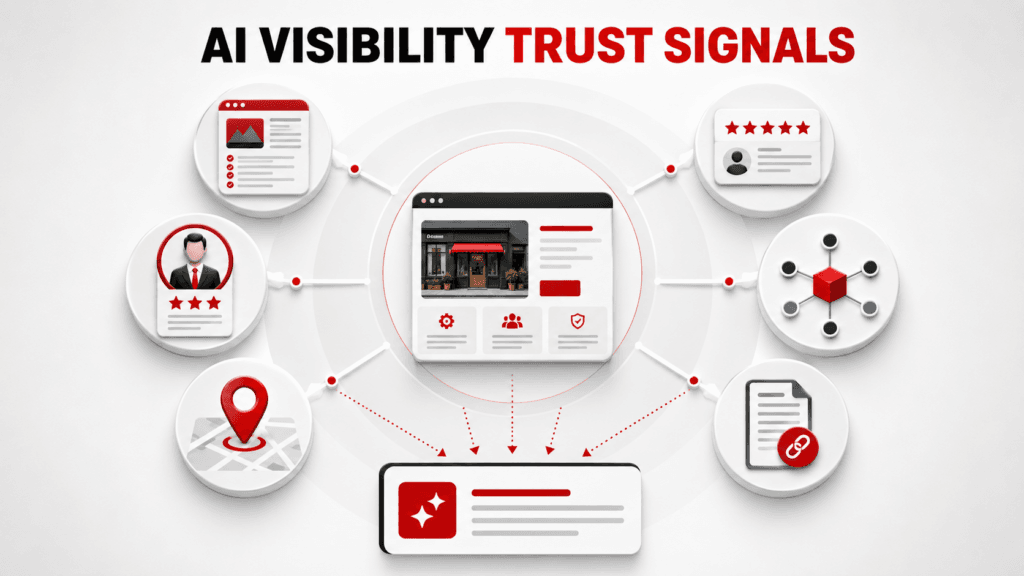
No single factor guarantees that a business will appear in an AI-generated response. Different platforms use different models, indexes, retrieval methods, databases, and quality systems.
However, several common foundations can improve a business’s overall discoverability.
1. Clear information about the business
The website should make it easy to determine:
- The business name
- Primary services
- Service locations
- Industries or customers served
- Contact information
- Areas of specialization
- Ownership or team information
- Credentials and relevant experience
Avoid relying on vague language such as “innovative solutions for all your needs.” Clearly state what the company does and who it helps.
2. Detailed service pages
A single page containing a short list of every service rarely provides enough depth.
Important services should generally have their own pages explaining:
- What the service includes
- Who needs it
- Problems it solves
- How the process works
- Factors affecting price or timing
- Common customer questions
- Related services
- Geographic availability
These pages help both customers and automated systems understand the business more precisely.
3. Firsthand expertise
Generic content can be found almost anywhere. Original experience is much harder to replace.
Small businesses can publish information based on:
- Customer questions
- Completed projects
- Consultations
- Common mistakes
- Industry changes
- Before-and-after situations
- Service limitations
- Cost considerations
- Lessons learned over many years
Google’s current guidance specifically emphasizes valuable, non-commodity content that offers something beyond widely repeated information. Google Search Central: AI optimization guidance
4. Consistent business information
A business’s name, address, phone number, website, hours, services, and locations should be represented accurately across relevant online sources.
For local businesses, this includes the website, Google Business Profile, major directories, industry listings, social profiles, review sites, and other trusted platforms.
Conflicting information creates uncertainty. Consistent information gives search and AI systems greater confidence that they have identified the correct business.
5. Reputation and third-party confirmation
A company’s website explains what it says about itself. Reviews, directory listings, professional memberships, interviews, media mentions, and other independent sources help confirm those claims.
For example, if a business describes itself as serving Frisco but its website, Google Business Profile, customer reviews, and local directory listings all support that connection, the geographic relationship becomes easier to verify.
6. A technically accessible website
Strong content will not reach its potential if search systems cannot reliably crawl, index, and interpret the website.
Important technical foundations include:
- Mobile-friendly design
- Secure HTTPS
- Reliable hosting
- Reasonable page speed
- Logical navigation
- Descriptive page titles
- Proper heading structure
- Internal links
- Indexable content
- Relevant structured data
- Accurate XML sitemaps
- No accidental search-engine blocking
Google confirms that standard technical SEO remains relevant to visibility in AI Overviews and AI Mode. Google Search Central: AI features and your website
A Practical Local-Business Example
Consider two HVAC companies serving the same North Texas community.
The first company has a five-page website. Its heating and air-conditioning services are mentioned briefly, but the site provides few details. Its service area is unclear, the blog has not been updated in several years, and its business information varies across directories.
The second company has:
- Separate pages for repair, maintenance, replacement, and indoor-air-quality services
- Clear references to the communities it serves
- Technician and company experience
- Answers to common pricing and maintenance questions
- Articles based on problems technicians encounter in North Texas homes
- Consistent contact information
- Active customer reviews
- Accurate local listings
- Project examples and original photographs
The second company has created a much stronger body of evidence.
That does not guarantee an AI recommendation. It does, however, make the business easier to understand, evaluate, and connect with, especially when addressing detailed customer questions.
Myth vs. Reality
Myth: AI visibility has replaced SEO
Reality: AI visibility builds on many of the same foundations as traditional SEO. Search accessibility, content quality, authority, relevance, and reputation remain important.
Myth: Every business needs a completely different website for AI search
Reality: Most small businesses do not need to start over. They usually need to improve the clarity, depth, organization, consistency, and credibility of their existing online presence.
Myth: Adding more AI-generated articles will automatically improve visibility
Reality: Publishing large amounts of repetitive content can create more pages without creating more value. Google warns that using generative AI to produce pages at scale without adding meaningful value may violate its spam policies. Google’s guidance on generative AI content
Myth: There is a special code that guarantees AI citations
Reality: Structured data can help systems interpret certain information, but no schema type or technical file guarantees inclusion. Google specifically says that special AI text files, including llms.txt, are not required for its generative search features. Google Search Central: Generative AI mythbusting
Myth: Website traffic is the only meaningful measurement
Reality: Traffic and leads remain important, but AI visibility may influence a customer before a click occurs. A brand mention, citation, summarized answer, map result, review, or business profile appearance may all contribute to the final decision.
TK Expert Tip: Publish the Knowledge You Already Have
Most small businesses do not need to invent dozens of new topics. They need to document what they already know.
Start with the questions customers repeatedly ask:
- How much does the service cost?
- How long does it take?
- What is included?
- What could cause the price to change?
- Can the problem be repaired, or does it require replacement?
- What should the customer do before an appointment?
- What mistakes should be avoided?
- How does the process work?
- How should someone compare providers?
- When is professional help necessary?
These questions can become service-page sections, blog posts, videos, FAQs, social posts, case studies, and email content.
This approach produces material that reflects real experience instead of repeating the same general information already found across the internet.
The TK Internet Marketing AI Visibility Method
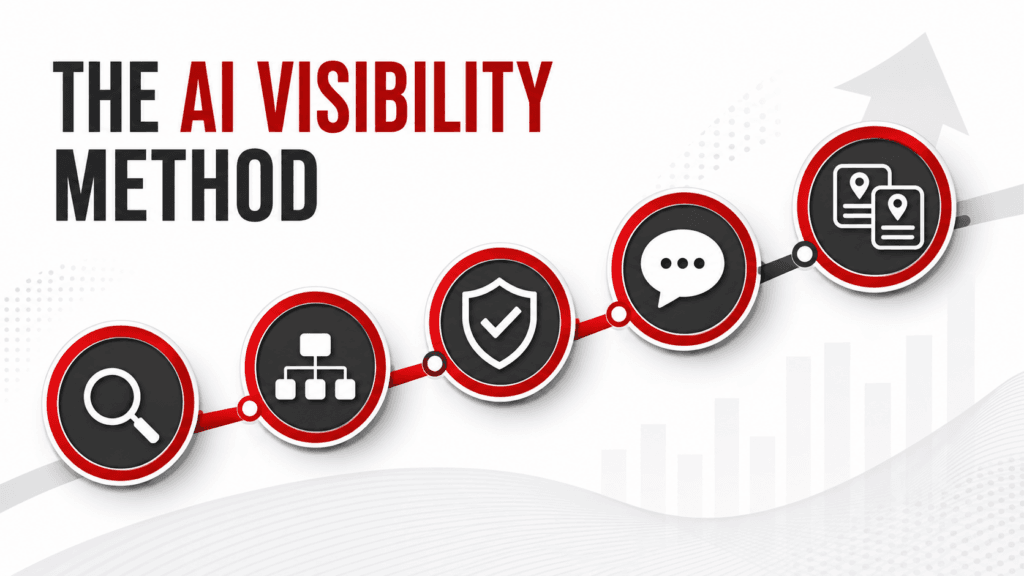
We recommend evaluating AI visibility through five connected areas.
1. Be discoverable
Search engines and other authorized systems must be able to find, crawl, and access the business’s important public information.
2. Be understandable
The website should clearly explain the company’s services, locations, expertise, customers, and areas of specialization.
3. Be credible
Claims should be supported by experience, author information, customer feedback, project evidence, accurate business profiles, and reputable third-party references.
4. Be useful
Content should answer genuine customer questions and provide specific information that helps people make decisions.
5. Be consistent
The business should present the same essential identity and service information across its website, local profiles, directories, social platforms, and other relevant sources.
Weakness in one area can affect the others. A useful website may still struggle if it cannot be crawled. A technically strong site may remain unclear if its service descriptions are vague. A company may publish excellent advice but weaken trust through outdated contact information or inconsistent listings.
Can AI Visibility Be Measured?
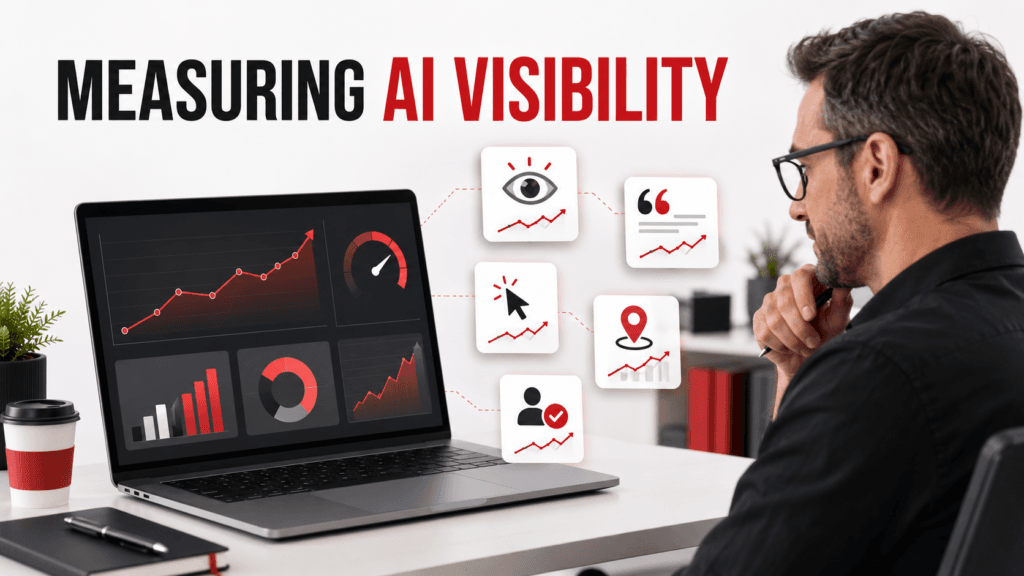
AI visibility measurement is still developing, but it is becoming more practical.
In June 2026, Google introduced dedicated generative AI performance reporting in Google Search Console. The reporting provides website owners with separate views of impressions associated with Google’s generative AI features, including AI Overviews, AI Mode, and generative experiences in Discover. Google Search Central: Generative AI performance reports
Businesses can begin monitoring:
- Generative AI impressions
- Clicks from supported AI search experiences
- Pages receiving AI visibility
- Questions and topics associated with discovery
- Referral traffic from AI platforms
- Brand mentions
- Citation appearances
- Local-profile engagement
- Leads influenced by AI-assisted research
These measurements should not be viewed in isolation. An impression does not automatically translate into a website visit, and a citation does not automatically generate a lead. The goal is to connect visibility with broader business outcomes.
A Simple AI Visibility Checklist
Small-business owners can begin by asking:
- Does our homepage clearly explain what we do and where we work?
- Does every important service have enough information?
- Are our business details consistent across the web?
- Is our Google Business Profile accurate and complete?
- Do we publish original information based on real experience?
- Do our pages answer the questions customers actually ask?
- Are our authors, owners, or experts clearly identified?
- Do we provide evidence supporting our claims?
- Does our website include relevant customer reviews or project examples?
- Can search engines crawl and index our important pages?
- Are related pages connected with internal links?
- Is outdated or conflicting information being corrected?
- Are we measuring more than keyword rankings?
- Have we reviewed Google Search Console’s AI reporting?
- Could an unfamiliar person quickly understand why our company is qualified?
You do not need to fix everything at once. Begin with the pages and services most closely connected to revenue.
FREE GUIDE
Want the Complete AI Visibility Checklist?
Get the Small Business Guide to AI Visibility for practical steps you can use to improve how your business is discovered, understood, and trusted in AI-powered search.
AI Visibility Is Really About Trust
The phrase “AI visibility” sounds technical, but the underlying goal is straightforward.
Your business needs to become a clear, useful, credible source of information.
When a customer—or an AI system acting on that customer’s request—tries to determine who you are, what you offer, where you work, and whether your information can be trusted, your online presence should provide strong and consistent answers.
That requires more than inserting keywords into a page. It requires bringing together:
- Technical website quality
- Helpful content
- Local SEO
- Clear service information
- Firsthand experience
- Business-profile accuracy
- Customer reputation
- Structured information
- Consistent brand signals
Small businesses that begin strengthening these areas now will be better prepared as customer discovery continues moving from lists of search results toward AI-assisted answers, comparisons, and recommendations.
Is Your Small Business Ready for AI Search?
AI visibility is not about chasing every new platform or reacting to every prediction about the future of search.
It is about making your business easier to discover, understand, verify, and trust—wherever customers look for answers.
TK Internet Marketing helps small businesses improve the foundations that support traditional SEO, local visibility, and emerging AI search experiences. This can include website content, service-page improvements, WordPress optimization, Google Business Profile support, local listings, structured data, reputation signals, and ongoing visibility reporting.
If you are unsure whether AI systems can accurately understand your business, an AI visibility review is a practical place to begin.
Contact TK Internet Marketing to discuss how your website and local online presence can be prepared for the next stage of customer discovery.
Coming Next in the Small Business Guide to AI Visibility
How AI Search Actually Works: What Small-Business Owners Need to Know
The next article will explain how AI search systems find, interpret, compare, and combine information—and why confidence signals, content structure, topical authority, and third-party sources matter.
