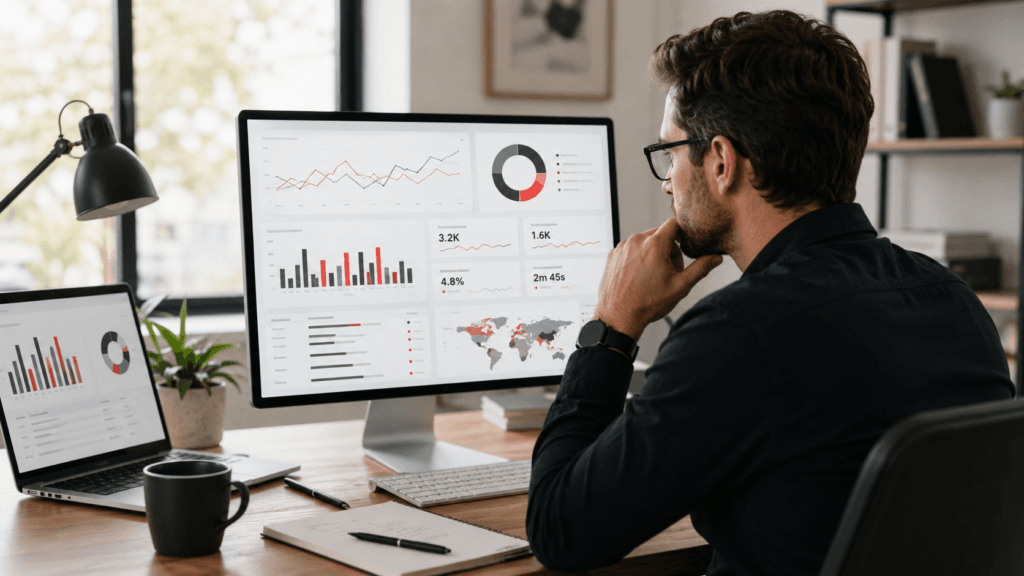
Google Search is changing—not only in how it answers questions, but also in how businesses measure their visibility.
For years, SEO reports have focused on familiar measurements such as keyword rankings, search impressions, organic clicks, website traffic and conversions. Those measurements remain important, but they no longer tell the entire story.
A business may now appear as a supporting source within a Google AI Overview or AI Mode response. The person searching may see the business’s information before visiting its website—or without clicking through at all.
Google took an important step toward measuring this new type of visibility on June 3, 2026, when it announced dedicated Search Generative AI performance reports in Google Search Console. These reports provide eligible website owners with information about how often their pages appear in Google’s generative AI search features.
For small businesses, this does not mean traditional SEO reporting should be abandoned. It means AI visibility should gradually become another part of the overall picture.
Google Search Is Changing How Website Visibility Is Measured
Traditional SEO reporting usually includes measurements such as:
- Keyword rankings
- Search impressions
- Organic clicks
- Click-through rates
- Website sessions
- Engagement
- Contact-form submissions
- Phone calls
- Sales or other conversions
These measurements help determine whether people can find a business and what they do after reaching its website.
Google’s AI-powered search experiences introduce an additional form of visibility.
When someone asks a complex question, Google may produce an AI-generated answer that includes links to supporting websites. A business’s page could be included as one of those supporting sources, even when it is not the first traditional organic result displayed below the answer.
Google explains that AI Overviews and AI Mode may use a process called “query fan-out,” in which Google performs multiple related searches across subtopics and data sources. This may allow a broader variety of relevant pages to appear as supporting links.
That creates new questions for business owners:
- Is our website appearing in AI-generated search results?
- Which pages are being shown?
- Are those pages receiving more or fewer AI impressions over time?
- Does that visibility eventually contribute to website visits or leads?
- Is the information presented about our business accurate?
Until recently, website owners had limited direct reporting from Google to help answer those questions.
What Is Google’s Generative AI Performance Report?
Google’s Generative AI Performance Report is a dedicated report within Google Search Console that shows how a website is appearing in supported generative AI features on Google Search.
Google announced the new Search and Discover reports on June 3, 2026. According to Google, the data was already included within overall Search Console performance reporting, but the new dedicated view makes generative AI visibility easier to identify and evaluate separately.
The Search report currently includes impressions from:
- Google AI Overviews
- Google AI Mode
Google says that the list of supported features may change as Google Search continues to develop. Experimental Search Labs data is not included.
What the Report Shows
The report currently allows website owners to review:
Impressions: The number of times links to the website were shown to a user within a supported generative AI feature.
Pages: The final or canonical URLs that appeared as links within generative AI search features.
Countries: The countries from which the searches originated.
Devices: Whether the search occurred on a desktop, mobile device or tablet.
Dates: Visibility over time, including daily, weekly and monthly reporting options.
The report also includes an export option, allowing the chart and table information to be downloaded for further analysis or client reporting.
Why You May Not See the Report Yet
The report is not yet available to every Google Search Console property.
Google is initially rolling it out to a subset of website owners for testing. A property may also not receive the report if the website has not generated enough impressions within Google’s generative AI features.
Therefore, the absence of the report does not necessarily indicate a technical problem.
An Important Reporting Limitation
At launch, the dedicated report emphasizes impressions and dimensions such as pages, dates, countries and devices.
Google’s current documentation does not list prompts, search queries or clicks as separate metrics within the dedicated report. It also does not provide a complete record of exactly how the website’s information was used within each generated answer.
An AI impression should therefore not be interpreted as:
- A website visit
- A lead
- A phone call
- A conversion
- Proof that the website influenced the final answer
- Proof that the searcher noticed or selected the link
It indicates that a link to the website was shown within a supported Google generative AI search feature.
Why This Reporting Change Matters for Small Businesses
Small businesses may assume that AI search reporting is primarily important for large publishers or national brands. In reality, local service providers often possess exactly the kind of specific, experience-based information people seek.
A potential customer may ask questions such as:
- How much should a particular service cost?
- What should I expect during an appointment?
- What is the difference between two service options?
- How can I identify a common problem?
- When should I call a professional?
- Which service is appropriate for my situation?
A well-written service page, FAQ or educational article can answer these questions while demonstrating the company’s experience.
If Google selects one of those pages as a supporting source in an AI-generated response, that appearance creates visibility—even when the searcher does not immediately visit the website.
AI Visibility Can Reveal Content Strengths
The Pages section of the report may help identify which topics Google associates with the website.
For example, a business may discover that:
- A detailed FAQ receives more AI impressions than its homepage.
- An older educational article continues to appear for relevant questions.
- A specialized service page gains visibility despite receiving modest traditional traffic.
- Several closely related pages receive no AI visibility and may need clearer differentiation.
- A page gains impressions after being updated with more complete information.
These observations can help guide content improvements, but they should not be evaluated in isolation.
The goal is not simply to accumulate AI impressions. The larger objective is to help potential customers find reliable information, understand the company’s expertise and eventually take an appropriate next step.
What Is Generative Engine Optimization?
Generative Engine Optimization, commonly abbreviated as GEO, is an emerging term for improving a website or brand’s visibility within AI-generated answers.
The term became more widely recognized following research presented at the 2024 ACM SIGKDD Conference on Knowledge Discovery and Data Mining. The research described GEO as a framework for evaluating and improving content visibility within generative engines.
In practical marketing discussions, GEO may refer to efforts to improve visibility within:
- Google AI Overviews
- Google AI Mode
- ChatGPT
- Gemini
- Microsoft Copilot
- Perplexity
- Other AI-powered discovery platforms
However, GEO is not an official Google ranking system, and there is no universally accepted formula that guarantees citations.
SEO and GEO Are Closely Connected
Traditional SEO helps make a website:
- Accessible to search engines
- Crawlable and indexable
- Relevant to a search
- Technically reliable
- Clearly organized
- Helpful to users
- Competitive in search results
GEO applies many of those same principles while paying additional attention to whether AI systems can understand, verify, summarize and potentially cite the information.
Google’s position is that optimizing for its generative AI search experiences remains part of SEO. Google specifically states that Answer Engine Optimization and Generative Engine Optimization are industry terms, while its AI search features continue to rely on Google’s existing search and quality systems.
In other words, businesses should not treat GEO as a replacement for SEO.
SEO Is Not Being Replaced by GEO
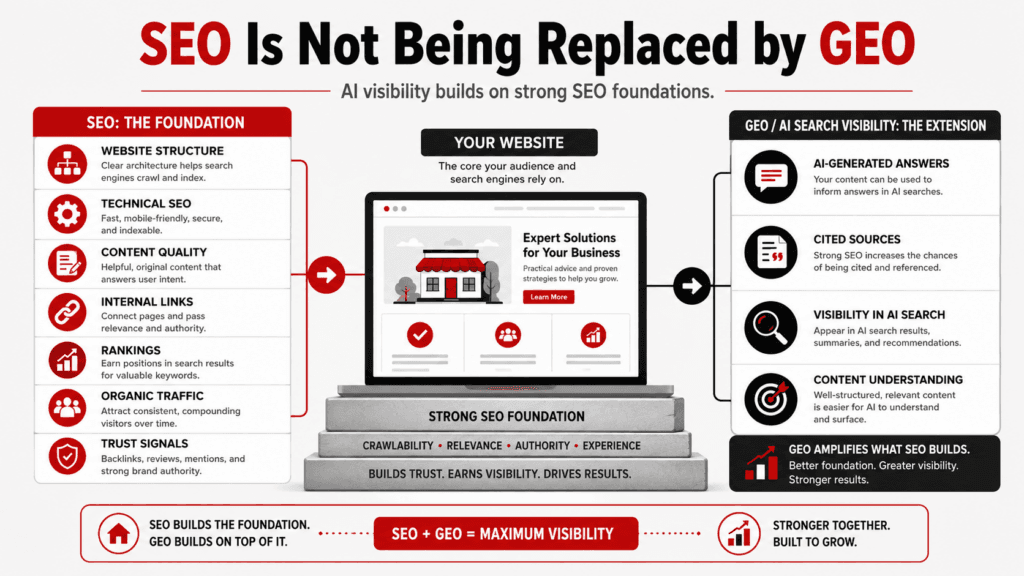
The increasing use of AI-generated answers has led to claims that traditional SEO is becoming obsolete.
That conclusion is premature.
Google says its AI search features use content from its Search index and remain grounded in core search ranking and quality systems. A page must be indexed and eligible to appear in Google Search with a snippet before it can be shown as a supporting link in AI Overviews or AI Mode.
The foundations still include:
- Crawlable and indexable pages
- Helpful, reliable content
- Clear website navigation
- Descriptive headings
- Relevant internal links
- Accurate titles and descriptions
- Mobile usability
- Website security
- Appropriate page performance
- Accurate business information
- Quality external references
- Properly implemented structured data
- An optimized Google Business Profile for local businesses
You Do Not Need Special AI Schema
Google states that there are no additional technical requirements or special optimizations needed to appear in AI Overviews or AI Mode. Existing SEO fundamentals remain applicable.
That means businesses do not need to:
- Install an unrecognized “AI schema”
- Create markup that Google does not support
- Add hidden text intended for AI systems
- Rewrite every page using an artificial formula
- Purchase a service promising guaranteed AI citations
Structured data remains useful when it accurately describes the visible page content and follows Google’s supported guidelines. It should not be presented as a shortcut to AI inclusion.
What Makes Content More Useful in AI Search?
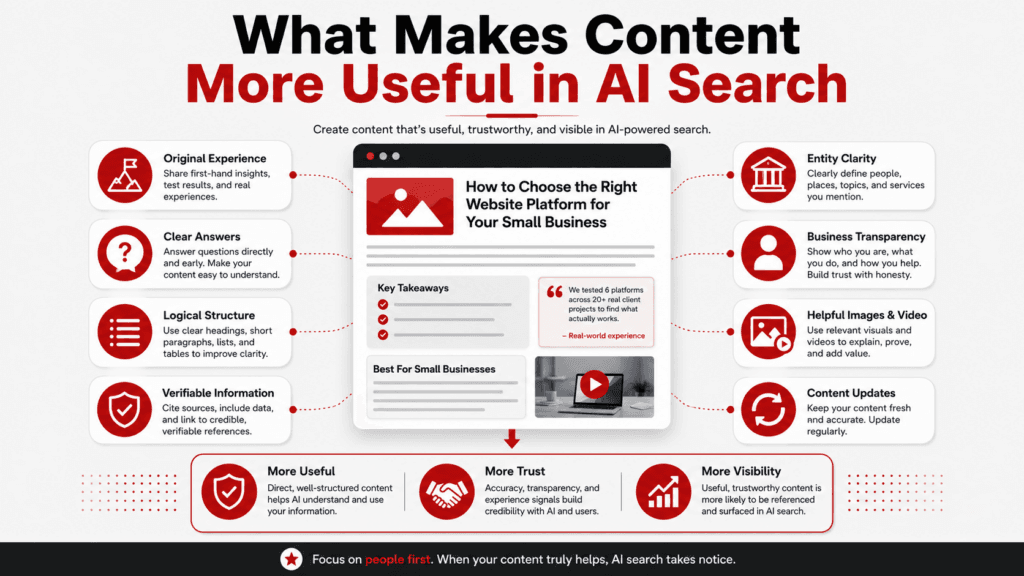
No single content tactic can guarantee placement in an AI-generated answer. However, businesses can make their information more useful, understandable and trustworthy.
Include Original Experience
One of the strongest resources a small business possesses is firsthand experience.
Business owners and employees regularly answer questions that may not be addressed clearly elsewhere online. Those answers can become valuable website content.
Experience-based information may include:
- Common questions customers ask
- Mistakes the company frequently encounters
- Factors that affect pricing or project timelines
- Situations in which one service is preferable to another
- Steps customers can take before requesting service
- Realistic expectations about a process
- Lessons learned through professional work
This information is usually more useful than generic content that merely repeats definitions already found across dozens of websites.
Answer the Main Question Clearly
Readers should not have to search through several paragraphs to find the basic answer.
A strong page often:
- States the primary answer early.
- Explains the reasoning.
- Provides important exceptions or limitations.
- Offers examples.
- Suggests a reasonable next step.
This structure helps visitors understand the content and makes the page easier to summarize accurately.
Organize Information Logically
Clear structure can improve usability for people and make page relationships easier for search systems to understand.
Useful structural elements include:
- Descriptive headings
- Concise definitions
- Comparison tables
- Numbered processes
- Relevant FAQs
- Clearly labeled examples
- Short paragraphs
- Internal links to supporting pages
The objective is clarity—not adding lists or FAQs merely because they appear “optimized.”
Use Verifiable Information
Important factual claims should be supported by authoritative sources when appropriate.
Good content distinguishes among:
- Verified facts
- Professional observations
- Estimates
- Opinions
- Predictions
- Customer-specific recommendations
Dates should also be included when discussing changing technology, policies, regulations or platform features.
Make the Business and Its Expertise Clear
AI visibility is not only about optimizing individual sentences. Search systems also need consistent information about the organization behind the content.
A trustworthy small-business website should clearly identify:
- The business name
- Services provided
- Service areas
- Contact information
- Team members
- Professional experience
- Relevant qualifications
- Editorial or review processes
- The author of important educational content
This information should be consistent across the website, Google Business Profile and reputable third-party listings.
Use Helpful Images and Videos
Images and videos should support the subject rather than merely decorate the page.
Depending on the business, useful media may include:
- Original project photographs
- Process diagrams
- Product comparisons
- Demonstration videos
- Before-and-after examples
- Annotated screenshots
- Team or facility photographs
Google encourages businesses to support their written content with high-quality images and videos when those formats help users understand the subject.
Review and Update Important Content
A strong article can lose value when dates, recommendations, screenshots or platform features become outdated.
Businesses should periodically review their most important content and ask:
- Is the information still accurate?
- Has the service changed?
- Are the cited sources current?
- Do the screenshots match the current interface?
- Are any links broken?
- Can we add new firsthand experience?
- Does another page now answer this question better?
An update should improve the page—not merely change the publication date.
Add AI Visibility to Monthly SEO Reporting
AI visibility should become part of monthly reporting when reliable information is available, but it should not replace existing measurements.
A balanced SEO report may include:
| Measurement | Current Period | Previous Period | Change | Recommended Action |
|---|---|---|---|---|
| Google generative AI impressions | Insert data | Insert data | Calculate | Review pages gaining visibility |
| Pages appearing in Google AI features | Insert data | Insert data | Calculate | Evaluate leading pages |
| Standard organic search impressions | Insert data | Insert data | Calculate | Review search demand |
| Organic clicks | Insert data | Insert data | Calculate | Evaluate click-through trends |
| Organic website sessions | Insert data | Insert data | Calculate | Compare with Search Console |
| Contact-form submissions | Insert data | Insert data | Calculate | Review conversion paths |
| Phone calls or other leads | Insert data | Insert data | Calculate | Assess lead quality |
| Documented third-party AI mentions | Insert observations | Insert observations | Describe | Verify accuracy and consistency |
What to Include in the Report
When Google’s Generative AI Performance Report is available, monthly reporting should consider:
- Total generative AI impressions
- Change from the previous period
- Pages receiving the most impressions
- New pages appearing in the report
- Pages that lost visibility
- Country or device patterns when relevant
- Traditional organic impressions and clicks
- Website sessions
- Leads and conversions
- Engagement on important landing pages
- Significant content or technical changes made during the period
The report should explain what the numbers mean and what action, if any, should be taken.
Simply adding another chart without interpretation does not help a business make better decisions.
How to Track Pages That Appear in AI Results
Businesses can use the following process to begin evaluating AI visibility.
1. Check Google Search Console
Look for the Generative AI Performance Report within the appropriate Search Console property.
The report may not yet be available because Google is limiting the initial rollout or because the website has not generated enough qualifying impressions.
2. Review the Pages Dimension
Identify which URLs have appeared as links within AI Overviews or AI Mode.
Look for patterns among:
- Service pages
- Blog articles
- FAQs
- Location pages
- Resource pages
- Older content
- Recently updated content
3. Export the Data
Use Search Console’s export function to preserve the reporting-period data and compare it with future periods.
4. Compare AI Visibility With Other Performance Data
A page with high AI impressions may receive limited website traffic. Another page may receive fewer impressions but generate more leads.
Compare the AI report with:
- Standard Search Console data
- Google Analytics
- Conversion tracking
- Contact forms
- Phone calls
- Customer inquiries
- Sales or appointment data
5. Document a Set of Relevant Questions
Create a consistent list of questions potential customers commonly ask.
Periodically test those questions in selected AI platforms and record whether:
- The business is cited with a link.
- The business is mentioned without a link.
- A competitor is cited.
- An industry source is cited.
- No sources are shown.
- The information about the business is inaccurate.
6. Treat Manual Testing as Directional
AI responses can vary according to:
- Platform
- User account
- Search history
- Location
- Prompt wording
- Date and time
- Model version
- Whether live web search is used
Therefore, one manual test is not conclusive evidence of visibility or absence.
Use consistent prompts and document the testing conditions whenever possible.
7. Improve Weak or Incomplete Pages
Once patterns emerge, update pages that lack:
- A clear primary answer
- Original experience
- Supporting evidence
- Useful examples
- Accurate business information
- Internal links
- Current dates or recommendations
- A logical next step for the reader
The goal is not to manipulate an AI system. It is to publish the most useful version of the page.
What Should Small Businesses Do Now?
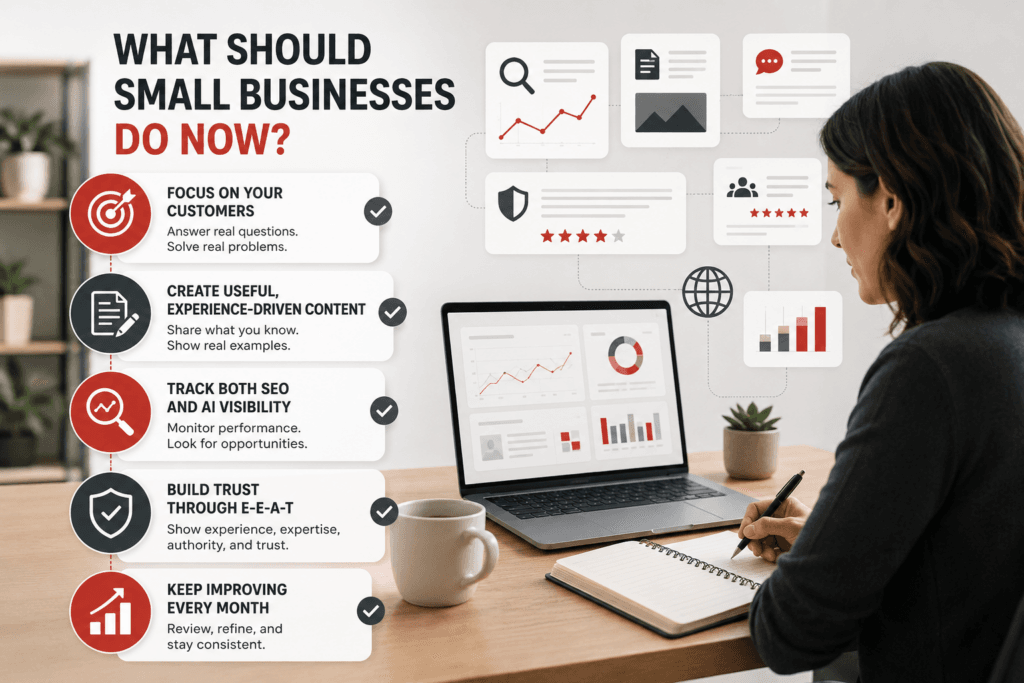
Small-business owners do not need to rebuild their entire marketing strategy because of one new Search Console report.
A practical approach is to take the following steps.
1. Check Whether the Report Is Available
Open Google Search Console and look for the Generative AI Performance Report.
Document when it becomes available so that future reporting comparisons use an appropriate starting point.
2. Add AI Visibility to Reports Carefully
Include generative AI impressions and visible pages when the data is available.
Label the metric clearly and explain that impressions do not equal clicks, leads or conversions.
3. Identify Pages Already Receiving Visibility
Review which service pages, articles or resources appear most frequently.
Those pages may reveal which subjects Google currently connects with the website.
4. Improve Important Service Pages
Make sure each major service page clearly explains:
- What the service is
- Who it is for
- What problems it addresses
- What the process involves
- What affects cost or timing
- Why the company is qualified
- What the customer should do next
5. Publish Content Based on Real Questions
Customer emails, support tickets, sales calls and consultations can provide valuable content ideas.
A question that is repeatedly answered privately may deserve a clear public answer on the website.
6. Strengthen E-E-A-T Signals
Review the website’s:
- About page
- Author biographies
- Team information
- Contact details
- Service descriptions
- Policies
- Testimonials
- Professional credentials
- Source citations
- Publication and update dates
These elements help visitors understand who is responsible for the content and why they should trust it.
7. Maintain Accurate Local Business Information
Keep the company’s name, address, phone number, services, hours and service areas consistent across:
- The website
- Google Business Profile
- Trusted directories
- Data aggregators
- Social profiles
- Industry associations
Consistent information supports local search and helps external systems understand the business as a distinct entity.
8. Review Structured Data
Structured data should accurately reflect the visible page content.
Use supported schema types that appropriately describe the organization, services, articles, authors, breadcrumbs and other eligible content. Do not add unsupported markup solely because it is promoted as “AI schema.”
9. Improve Internal Linking
Connect related articles, service pages, location pages and supporting resources.
Internal links help readers continue their research and help search systems understand the relationships among topics.
10. Continue Measuring Business Results
AI visibility is a developing measurement, not the final business objective.
Continue monitoring:
- Qualified leads
- Phone calls
- Contact forms
- Appointments
- Sales
- Revenue
- Customer acquisition
- Lead quality
A successful marketing strategy should contribute to meaningful business outcomes.
How TK Internet Marketing Helps Businesses Prepare for AI Search
AI search does not eliminate the need for a strong website. It increases the importance of publishing accurate, useful and clearly organized information.
TK Internet Marketing helps small businesses improve their visibility through:
- WordPress website improvements
- WordPress maintenance
- Technical SEO reviews
- Local SEO
- Google Business Profile optimization
- Content planning and writing
- Structured data reviews
- Internal linking
- Search Console analysis
- Traditional and AI search visibility reporting
Our approach focuses on practical improvements rather than promises of guaranteed rankings or AI citations.
If you are unsure how your website is appearing in traditional or AI-powered search, a Local SEO Audit can help identify technical issues, content gaps and opportunities to improve how your business is represented online.
Frequently Asked Questions
What is Google’s Generative AI Performance Report?
It is a dedicated Google Search Console report that shows impressions generated when links to a website appear within supported generative AI features on Google Search. The Search report currently includes AI Overviews and AI Mode.
Does the Report Show AI Overview Clicks?
Google’s current documentation for the dedicated report identifies impressions, pages, countries, devices and dates. It does not currently list clicks as a separate metric within that report.
Why Don’t I See the Report in Search Console?
Google is initially rolling out the report to a subset of website owners. Your website may also lack enough generative AI impressions for the report to appear.
Can Search Console Show When ChatGPT Cites My Website?
No. Google Search Console reports visibility within supported Google Search experiences. It does not report citations from ChatGPT, Microsoft Copilot, Perplexity or other independent platforms.
Is GEO Replacing SEO?
No. GEO is an emerging industry term focused on visibility in generative search experiences. Google considers optimization for its AI search features part of SEO because those features rely on Google’s search index and existing ranking and quality systems.
Do I Need Special Schema for AI Search?
No special schema is required to appear in Google AI Overviews or AI Mode. Pages must meet Google’s normal technical requirements and be eligible for indexing and search snippets.
How Can a Small Business Improve Its Chances of Being Cited?
Publish accurate, original and clearly organized content based on real customer questions and professional experience. Maintain strong technical SEO, internal linking, business transparency and consistent information. No tactic can guarantee an AI citation.
Should AI Impressions Be Included in Monthly SEO Reports?
Yes, when reliable data is available. However, AI impressions should be reported alongside organic traffic, clicks, leads and conversions—not treated as a replacement for them.
The Final Takeaway
Google’s new Generative AI Performance Report represents an important step toward understanding how websites appear within AI-powered search.
For the first time, eligible website owners can more easily identify which pages are being shown in Google AI Overviews and AI Mode and monitor how those impressions change over time.
However, the report has limitations. It does not provide a complete view of prompts, clicks, citations or visibility across every AI platform. An impression also does not automatically represent a website visit or customer inquiry.
The strongest strategy remains grounded in the fundamentals:
- Maintain a technically sound website.
- Publish original, experience-based information.
- Answer customer questions clearly.
- Keep business information accurate.
- Use appropriate structured data.
- Build logical internal links.
- Demonstrate real expertise and trustworthiness.
- Measure leads and customer outcomes.
AI visibility should become part of modern SEO reporting, but it should remain one component of a broader strategy focused on helping customers and growing the business.
