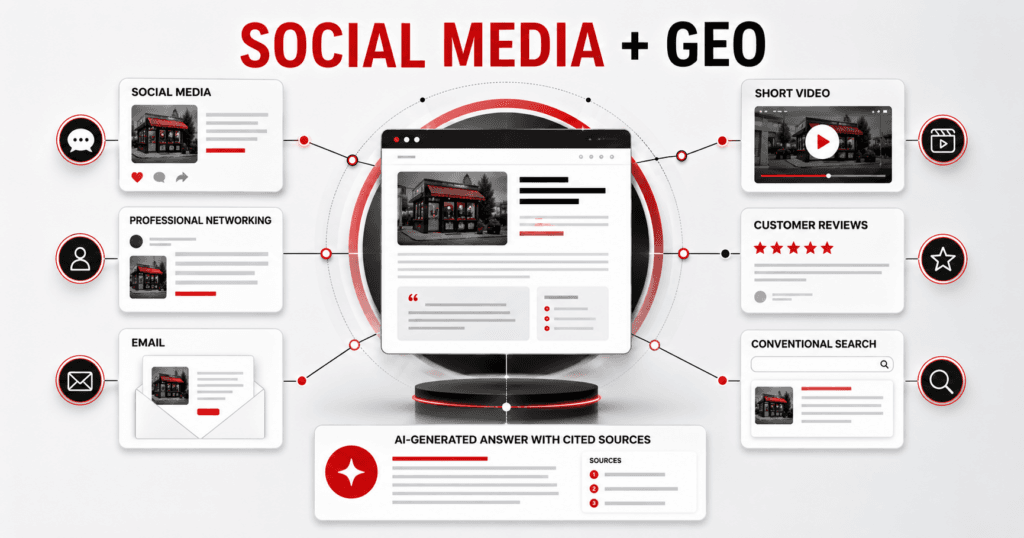
The way customers discover businesses online is changing.
People still use traditional Google searches, local listings, social media, referrals, reviews, and business websites. Increasingly, however, they are also asking AI platforms to recommend companies, compare services, explain products, and identify trusted experts.
A potential customer might ask:
- “Who can help improve my small-business WordPress website?”
- “What should I look for in a local SEO company?”
- “Which businesses offer professional charity auction services in Texas?”
- “How can my company improve its visibility in AI search?”
Instead of displaying only a list of blue links, an AI platform may generate a direct answer based on information gathered from multiple online sources.
This shift has led to growing interest in Generative Engine Optimization, commonly called GEO.
GEO does not replace traditional search engine optimization. It expands the goal. Businesses must still make their websites accessible, useful, technically sound, and relevant to traditional search engines. They must also make their expertise, experience, services, and reputation easier for AI systems to understand and verify.
Google’s official guidance confirms that established SEO practices remain relevant to its generative AI search features because AI Overviews and AI Mode continue to rely on Google’s search index, ranking systems, and quality systems.
For small businesses, this means the best GEO strategy is not chasing shortcuts. It is building a stronger, more credible online presence.
What Is Generative Engine Optimization?
Generative Engine Optimization is the process of improving a company’s online content and authority so that generative AI systems can more easily understand, retrieve, summarize, mention, or cite the business.
Traditional SEO generally focuses on outcomes such as:
- Search rankings
- Organic website traffic
- Click-through rates
- Local map visibility
- Leads and conversions
GEO introduces additional visibility goals, including:
- Being mentioned in AI-generated answers
- Being cited as a source
- Having content summarized accurately
- Appearing in AI-generated comparisons
- Being recognized as an expert or trusted provider
- Increasing brand visibility even when a traditional website click does not occur
These goals overlap. A technically sound website with original content, clear service information, strong local signals, credible authorship, and trustworthy third-party mentions can support both traditional SEO and AI discovery.
Google does not treat GEO as a separate replacement for SEO. From Google’s perspective, optimizing for generative AI search is still part of creating a high-quality search experience.
However, the way success is measured is beginning to change.
In February 2026, Microsoft introduced the AI Performance dashboard in Bing Webmaster Tools. The report shows when pages from a website are cited in AI-generated answers across Microsoft Copilot and related experiences. Metrics include total citations and the pages most frequently used as sources.
This is an important development because it gives website owners a clearer way to measure visibility beyond rankings and clicks.
GEO Does Not Replace Traditional SEO
Some marketing discussions make GEO sound like an entirely new discipline that requires businesses to abandon everything they previously learned about SEO.
That is misleading.
A page generally must still be crawlable, indexable, understandable, and eligible to appear in search before it can be considered for many AI-powered Google experiences. Meeting those requirements does not guarantee inclusion, but ignoring them can limit visibility.
Foundational SEO practices still matter:
- Helpful, original content
- Clear page titles and headings
- Fast, mobile-friendly websites
- Internal linking
- Descriptive images
- Accurate business information
- Google Business Profile optimization
- Structured data where appropriate
- Quality backlinks and mentions
- Strong author and company information
- Positive customer experiences
The difference is that businesses must begin evaluating more than where a page ranks.
They should also ask:
- Is our company mentioned in AI-generated answers?
- Which pages are being cited?
- Are AI systems describing our services accurately?
- Which external sources mention our brand?
- Do our case studies demonstrate genuine experience?
- Is our business information consistent across the web?
- Does our content offer anything original enough to cite?
GEO is therefore best viewed as an extension of a strong SEO, content, reputation, and branding strategy.
Why Social Media Matters for AI Discoverability
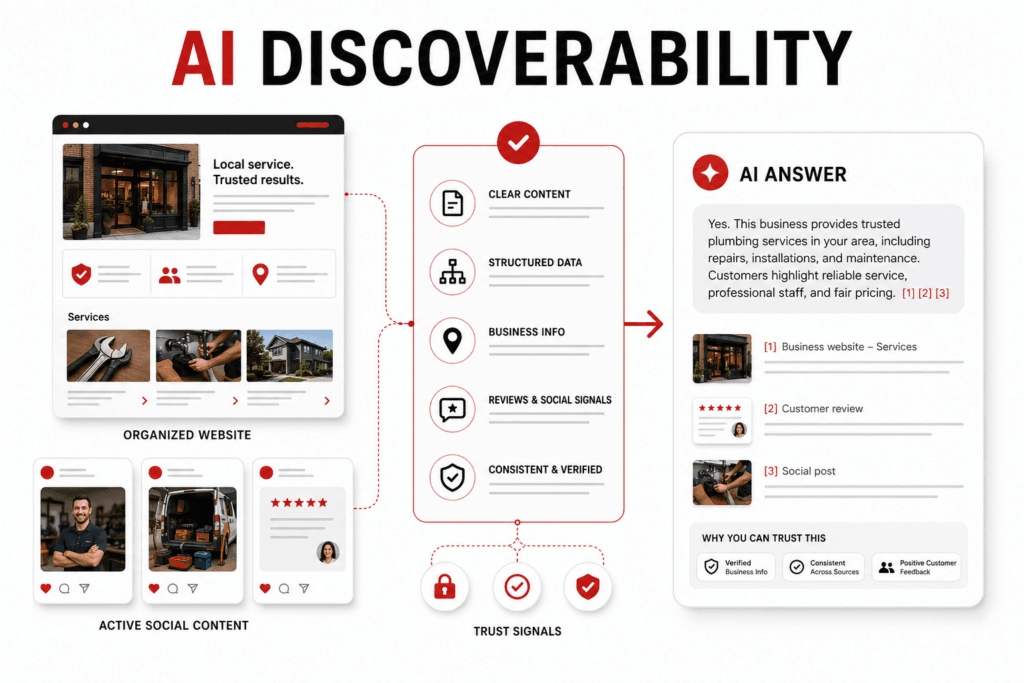
Social media does not automatically cause a company to appear in ChatGPT, Gemini, Copilot, or Google AI Overviews.
Posting every day is not a guarantee of AI visibility.
Social media can, however, strengthen the broader online presence that helps people and technology understand a company.
A credible social presence can reinforce:
- Who the company serves
- Which services it provides
- What subjects its team understands
- Whether the business is currently active
- What customers and professional peers say about it
- Where its original ideas and resources can be found
Social content also helps distribute website content to people who may reference, quote, link to, or discuss it elsewhere.
This matters because AI systems may retrieve information from a different mix of sources than traditional search results. A 2026 study comparing traditional Google results, Google AI Overviews, and Gemini found substantial differences between the sources returned by each system. The study also found that AI-generated results could vary between repeated or slightly modified queries.
Businesses should therefore avoid relying on one platform or one type of content.
A blog article on the company website may provide the most complete explanation. A LinkedIn post may introduce the idea to an industry audience. A video may demonstrate firsthand experience. A customer review may independently verify the quality of the service.
Together, these assets create a more complete and consistent digital footprint.
Helpful Social Content Is More Valuable Than Frequent Promotion
Publishing more social posts is not necessarily better.
A company that posts generic promotional messages five times a week may demonstrate less expertise than a company that posts one useful, original observation based on actual client work.
Strong social content can include:
- Lessons learned from a completed project
- Answers to recurring client questions
- Commentary about an industry development
- Explanations of the company’s process
- Short client success stories
- Common mistakes to avoid
- Original research or observations
- Practical checklists
- Links to more detailed website resources
LinkedIn can be especially valuable for consultants, agencies, nonprofit leaders, professional service providers, and business-to-business companies.
Research published by Edelman and LinkedIn has repeatedly emphasized the role of credible thought leadership in building trust and influencing decision-makers. Its 2025 report described thought leadership as a strategic way to build confidence, create alignment, and reach decision-makers who may not respond to traditional sales efforts.
The goal should not be to sound like a national celebrity or industry guru. Small-business thought leadership can simply mean sharing useful knowledge gained from real work.
The Paid Brand Mention Challenge
As AI recommendations become more commercially valuable, businesses and marketers are looking for ways to influence which brands are mentioned.
This has created what might be called the paid brand mention challenge.
Paid visibility can include:
- Sponsored articles
- Influencer partnerships
- Affiliate reviews
- Advertorials
- Paid directory listings
- Product placements
- Sponsored videos
- Promotional list articles
- Public-relations campaigns
These methods are not automatically unethical or ineffective. A well-disclosed sponsored campaign can introduce a business to a relevant audience.
The problem occurs when paid exposure is presented as independent authority or when brands attempt to manufacture the appearance of broad, unbiased support.
Recent reporting has described businesses strategically placing promotional language and favorable brand claims across websites in an effort to influence chatbot recommendations. This raises questions about whether AI-generated recommendations always distinguish genuine authority from coordinated marketing.
The growing value of AI visibility is also encouraging new partnerships between brands, publishers, and media companies. Businesses increasingly want credible third-party coverage that may improve both public awareness and visibility inside AI-generated results.
Small businesses should not interpret this trend as a reason to purchase as many mentions as possible.
Instead, paid exposure should support a broader strategy that includes:
- Transparent disclosures
- Genuine customer reviews
- Original case studies
- Accurate service information
- Expert commentary
- Reputable business listings
- Independent references
- Helpful educational content
- Consistent branding and company information
A paid article may create awareness. It does not automatically create trust.
Earned Authority Is More Sustainable Than Manufactured Visibility
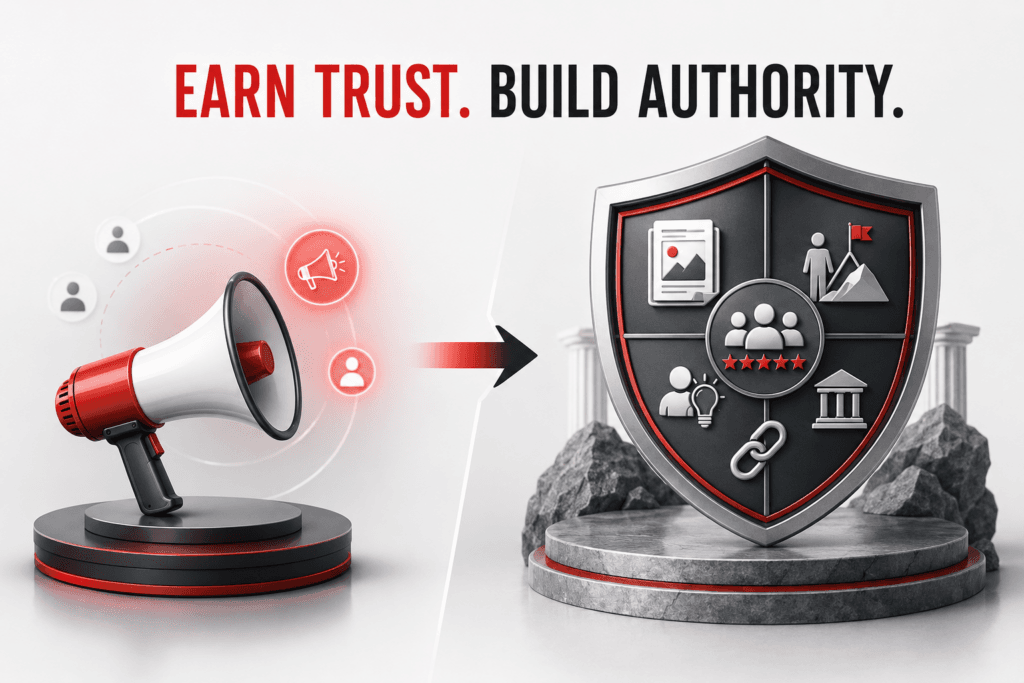
Earned authority develops when other people have legitimate reasons to discuss, recommend, quote, or link to a business.
Examples include:
- A customer leaving a detailed review
- A local organization recognizing a company’s work
- An industry publication quoting a team member
- A nonprofit acknowledging a business partner
- A journalist referencing original research
- A professional association listing a credential
- A client linking to a completed case study
- Another expert recommending a useful guide
These mentions are valuable because they provide independent context.
AI platforms do not all use sources in the same way, and no business can control every answer they generate. However, credible and consistent information from multiple sources gives AI systems and potential customers more evidence to evaluate.
Businesses should be particularly cautious about agencies promising guaranteed ChatGPT mentions, permanent AI rankings, or immediate citation results.
No ethical marketing provider can guarantee that an independent AI platform will cite a particular business.
Why Original Case Studies Build Authority
One of the strongest ways to demonstrate experience is to document real work.
A generic article can explain what a company knows. A case study can show how that knowledge was applied.
A useful case study explains:
- The client or industry background
- The original problem
- The strategy that was recommended
- The work that was completed
- The results or improvements
- Challenges encountered along the way
- Lessons that could help other businesses
- A client comment or testimonial, when available
Case studies support E-E-A-T because they provide evidence of firsthand experience.
For example, a WordPress marketing company could publish a case study explaining how it:
- Improved a client’s website structure
- Consolidated duplicate service pages
- Strengthened local landing pages
- Resolved a hacked website
- Increased visibility through better Google Business Profile content
- Improved website maintenance procedures
- Repurposed a blog into a newsletter, social posts, and video content
The strongest case studies are specific without exaggerating.
Businesses should explain the context behind any performance results. A percentage increase without dates, starting figures, or an explanation of the work can be misleading.
Client privacy must also be respected. Obtain permission before identifying a client, sharing private analytics, or publishing sensitive business information. An anonymized case study can still be effective when identifying details cannot be disclosed.
Why Original Content Matters More in an AI-Saturated Internet
AI tools have made it easier to publish content quickly. They have also made it easier to publish repetitive articles that offer little new information.
This creates an opportunity for small businesses with genuine expertise.
A recent analysis warned that the increasing volume of AI-generated material can create repetitive feedback loops in which online content becomes less diverse and less original.
A business does not need to avoid AI writing tools completely. AI can assist with planning, outlining, editing, repurposing, and organizing ideas.
The finished content should still contain something the business uniquely knows.
That might include:
- A real client question
- A mistake observed during a project
- Original photos
- A firsthand comparison
- A documented process
- A local market observation
- A client outcome
- A professional opinion based on experience
- A limitation that other articles fail to mention
The more generic the internet becomes, the more valuable real experience becomes.
Strengthening LinkedIn Thought Leadership

LinkedIn thought leadership should not consist only of sharing links to company blog articles.
A strong LinkedIn strategy includes original commentary from the people doing the work.
Business owners and company leaders can publish posts about:
- What they learned from a recent project
- Why they recommended one solution over another
- Changes they are seeing in their industry
- Questions clients are asking
- Mistakes businesses should avoid
- How they measure success
- Where common industry advice may be incomplete
- How new technology affects small businesses
Personal profiles and company pages serve different purposes.
A personal profile can create stronger conversations because readers are interacting with an individual. A company page provides an official publishing channel and reinforces the brand’s expertise.
The two should work together.
For example, the company page could publish the complete article. The owner could then share a personal observation from the article, explain why the subject matters, and invite discussion.
Avoid copying the same promotional paragraph across every profile.
Repurpose One Strong Article Into Multiple Content Assets
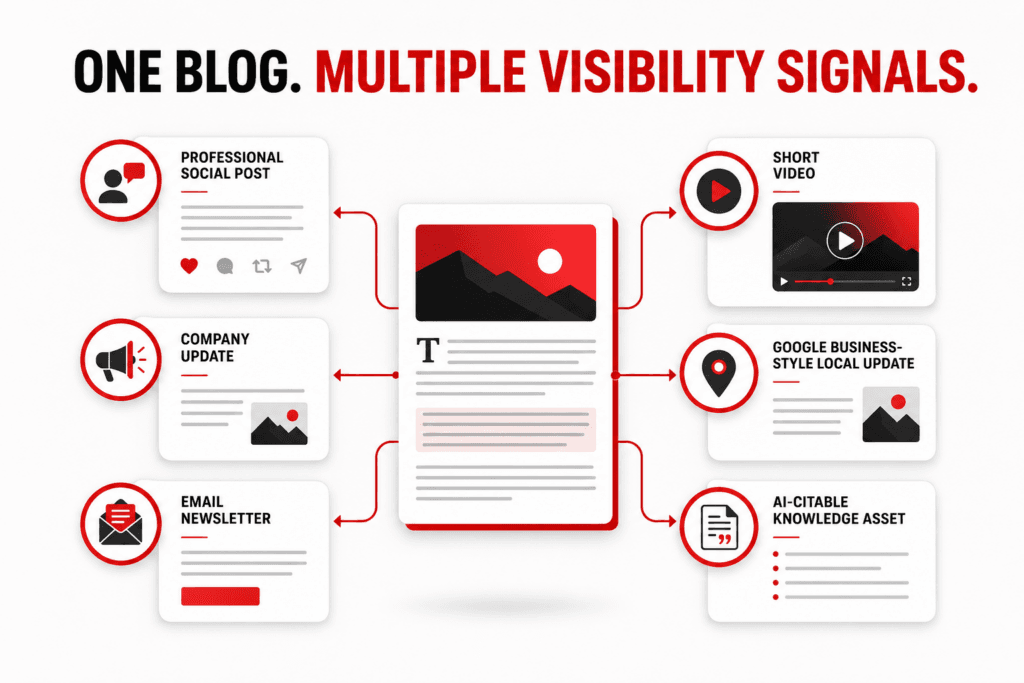
Publishing a useful article is only the first step.
Many businesses spend hours producing a blog post, publish it once, share it one time, and then move on to the next subject.
A stronger approach is to treat the original article as the central resource for a larger content campaign.
One blog article can become:
- A LinkedIn personal post
- A LinkedIn company post
- A Google Business Profile post
- A newsletter section
- A short educational video
- A longer YouTube discussion
- A series of frequently asked questions
- A presentation
- A downloadable checklist
- A support article
- A client email
- Several shorter social posts
Repurposing increases the number of opportunities for people to discover and engage with the idea.
It also reinforces the company’s topical focus.
However, repurposing should not mean copying the exact article into every platform. Each version should be adapted.
A Google Business Profile post should be brief and locally relevant. A LinkedIn personal post can include a professional opinion. A video should sound conversational. A newsletter should explain why the article is worth the reader’s time.
The underlying message remains consistent, but the presentation changes.
How E-E-A-T Supports GEO
E-E-A-T stands for:
- Experience
- Expertise
- Authoritativeness
- Trustworthiness
It is not a single score displayed inside Google Search Console. It is also not something a plugin can automatically add to a website.
E-E-A-T is demonstrated through the quality and credibility of the entire online presence.
A small business can strengthen these signals through:
- Detailed author biographies
- Accurate About pages
- Clear business contact information
- Original examples and photographs
- Documented client experience
- Professional credentials
- Transparent service descriptions
- Helpful editorial content
- Appropriate source citations
- Genuine customer reviews
- Updated articles
- Clear privacy and business policies
- Consistent local business information
- Honest explanations of limitations
Structured data can help search engines understand information, but schema markup does not create authority by itself.
Similarly, adding an author box does not establish expertise when the website provides no evidence of real experience.
Trust must be demonstrated throughout the website and across the broader online presence.
Can You Guarantee That ChatGPT Will Mention Your Business?
No.
No marketing company, SEO provider, software platform, or content writer can guarantee that ChatGPT, Gemini, Copilot, Perplexity, Google AI Mode, or another AI system will cite or recommend a particular business.
AI-generated answers can vary based on:
- The exact wording of the prompt
- The user’s location
- The AI platform
- The model version
- Available search results
- The date of the request
- Personalization
- The sources retrieved
- The type of question
- Changes to platform policies and systems
Research has also found that AI-generated source selections can vary between platforms and between similar versions of a question.
Businesses can improve how clearly and credibly they are represented online. They cannot control every generated answer.
Be cautious of GEO services promising:
- Guaranteed AI rankings
- Guaranteed ChatGPT recommendations
- Permanent AI citations
- Instant authority
- A secret schema code that forces AI mentions
- A certain number of citations within a fixed period
Responsible GEO focuses on increasing eligibility, credibility, clarity, and discoverability—not guaranteeing an outcome controlled by another company.
A Practical GEO Action Plan for Small Businesses
Small businesses do not need to rebuild their entire marketing strategy overnight.
Start with these priorities.
1. Review Your Core Website Content
Make sure your primary service pages clearly explain:
- What you do
- Who you serve
- Where you work
- How your process works
- Why your experience matters
- How customers can contact you
Avoid vague marketing language that could apply to almost any company.
2. Publish Original Case Studies
Document real work, decisions, challenges, and outcomes.
A modest but specific result is more credible than an unsupported claim of extraordinary success.
3. Strengthen LinkedIn Thought Leadership
Encourage company leaders to share professional observations and lessons from actual work.
Use the company page to support and organize the brand’s official content.
4. Repurpose Important Content
Turn each substantial article into newsletter, social, video, FAQ, and Google Business Profile content.
5. Improve Author and Company Credibility
Review About pages, author biographies, credentials, contact information, service descriptions, testimonials, and business policies.
6. Earn Legitimate Reviews and Mentions
Ask satisfied customers for honest reviews. Build relationships with local organizations, associations, publications, and professional partners.
7. Maintain Accurate Business Listings
Keep the business name, address, phone number, services, hours, and website information consistent across major directories and data providers.
Google specifically notes that Google Business Profiles can help local business information appear across traditional and AI-powered search experiences.
8. Cite Credible Sources
When an article discusses research, platform features, laws, or technical guidance, link to reliable primary sources.
9. Update Existing Content
Older articles may already have history, links, and visibility. Updating them can be more valuable than continually producing new but overlapping content.
10. Expand Your Reporting
Continue tracking rankings, traffic, calls, forms, and conversions.
Also begin monitoring:
- AI referral traffic
- AI citations
- Pages cited by AI systems
- Branded searches
- Unlinked brand mentions
- Assisted conversions
- Bing Webmaster Tools AI Performance
- Changes in how AI platforms describe the company
The available measurement tools are still developing. Bing’s AI Performance report is an early example of reporting shifting from rankings alone toward citation visibility.
How TK Internet Marketing Helps Businesses Prepare for AI Search
TK Internet Marketing helps small businesses create the strong digital foundation needed for both traditional search and emerging AI discovery.
Our services can include:
- WordPress content strategy
- Website content improvements
- Local SEO
- Google Business Profile optimization
- Blog writing
- Case-study development
- LinkedIn content
- Content repurposing
- Internal linking
- Structured data and schema support
- Local business listing improvements
- Website security and maintenance
- Ongoing WordPress support
We do not promise guaranteed ChatGPT mentions or permanent AI citations.
Instead, we help businesses make their services, expertise, experience, and local relevance easier for customers, search engines, and AI systems to understand.
That begins with a useful website, original content, consistent business information, and a long-term commitment to credibility.
Build Authority Before Chasing the Next AI Trend
Small businesses do not need to chase every new GEO tactic or rebuild their marketing strategy every time an AI platform announces a feature.
The fundamentals remain valuable:
- Do good work.
- Explain it clearly.
- Document real experience.
- Publish useful information.
- Build a trustworthy reputation.
- Maintain accurate business information.
- Distribute your best content across multiple channels.
Traditional rankings still matter. Website traffic still matters. Calls, form submissions, qualified leads, and sales still matter.
AI visibility is becoming another part of that larger marketing picture.
The businesses most prepared for this change will not necessarily be the ones that publish the most content or purchase the most mentions. They will be the businesses that consistently demonstrate why their information and experience deserve to be trusted.
Would you like to strengthen your website content, local visibility, and readiness for AI-powered search? Contact TK Internet Marketing to discuss a practical WordPress and local marketing strategy for your business.
Frequently Asked Questions
What is Generative Engine Optimization?
Generative Engine Optimization is the practice of improving online content and authority so AI systems can more easily understand, retrieve, mention, summarize, or cite a business.
Is GEO replacing traditional SEO?
No. GEO builds upon traditional SEO. Technical accessibility, helpful content, internal linking, local optimization, authority, and user experience remain important.
How can a small business get mentioned by ChatGPT?
There is no guaranteed method. Businesses can improve their discoverability by publishing original content, maintaining accurate business information, earning credible reviews and mentions, and demonstrating real expertise across their website and public profiles.
Do social media posts help with AI search visibility?
They can support a broader authority and content-distribution strategy, but posting alone does not guarantee an AI citation. Useful, original content is more valuable than high posting frequency.
Are paid brand mentions useful for GEO?
Paid mentions may increase awareness, but they do not automatically establish trust or authority. They should be transparent and should support—not replace—earned reviews, case studies, expert content, and independent references.
Can an SEO company guarantee AI citations?
No. AI platforms control their own retrieval, recommendation, and citation systems. A responsible SEO company can improve a business’s digital foundation and discoverability but cannot guarantee a specific AI-generated result.
