

Over the past few years, small business owners have become increasingly familiar with AI-powered search experiences from Google, ChatGPT, Microsoft Copilot, Gemini, and other AI assistants.
These tools are already changing how customers discover businesses, research services, compare options, and make purchasing decisions.
But another change is underway.
Instead of simply answering questions, AI systems are becoming increasingly capable of taking actions on behalf of users.
These systems are often referred to as AI agents or agentic AI.
Imagine a customer saying:
“Find me a highly rated HVAC company near me that offers financing and can schedule an appointment next Tuesday.”
Instead of simply presenting a list of websites, an AI assistant could increasingly help research companies, compare services and reviews, navigate websites, check available options, fill out forms, or assist with completing a booking.
That capability is no longer purely theoretical. Microsoft, for example, has introduced browser-based Copilot capabilities that can navigate webpages, select options, type into fields, and perform supported actions. Google is also developing technologies specifically designed to help websites interact more reliably with browser-based AI agents.
For small businesses, this creates an important question:
Is your website ready not only to be found by AI, but also to be understood and used by it?
The encouraging part is that many of the practices that help people and traditional search engines understand your business also provide a strong foundation for an AI-driven web.
AI Agents Are Already Taking Shape
It would be easy to think that AI agents are still several years away.
The technology, however, is already moving beyond chatbots that simply answer questions.
AI systems are increasingly capable of:
- Browsing websites
- Researching products and services
- Comparing information from multiple sources
- Navigating webpages
- Working across applications
- Completing multi-step tasks
- Filling out supported forms
- Using external tools and services when authorized
Google described this transition at Google I/O 2026 as a move from AI that simply assists users toward agents that can navigate more complex workflows. Google is also testing WebMCP, a proposed web technology designed to let websites expose structured tools and forms that browser-based agents can use more reliably.
Microsoft’s Browse with Copilot similarly allows Copilot to interact with webpages by selecting, typing, scrolling, and navigating while the user remains able to monitor or take control.
The technology is still evolving, and different platforms will approach it differently.
But the direction is becoming clearer:
AI is moving from helping people find information toward helping them accomplish tasks.
For businesses, that means the future of website optimization may involve more than ranking well.
Your website also needs to make your business easy to understand, evaluate, and interact with.
What Is an AI Agent?
Traditional search engines primarily help people find information.
AI agents are designed to help people accomplish objectives.
Depending on the platform, permissions, website, and task, an AI assistant may eventually help someone:
- Compare businesses
- Research products
- Check service availability
- Request information
- Fill out forms
- Schedule appointments
- Make reservations
- Add products to a shopping cart
- Complete supported purchases
- Coordinate information between applications
Not every AI assistant can perform every one of these actions today, and websites may restrict automated access.
But the underlying change is important.
Customers may increasingly tell an AI assistant what they want accomplished rather than manually searching through multiple websites themselves.
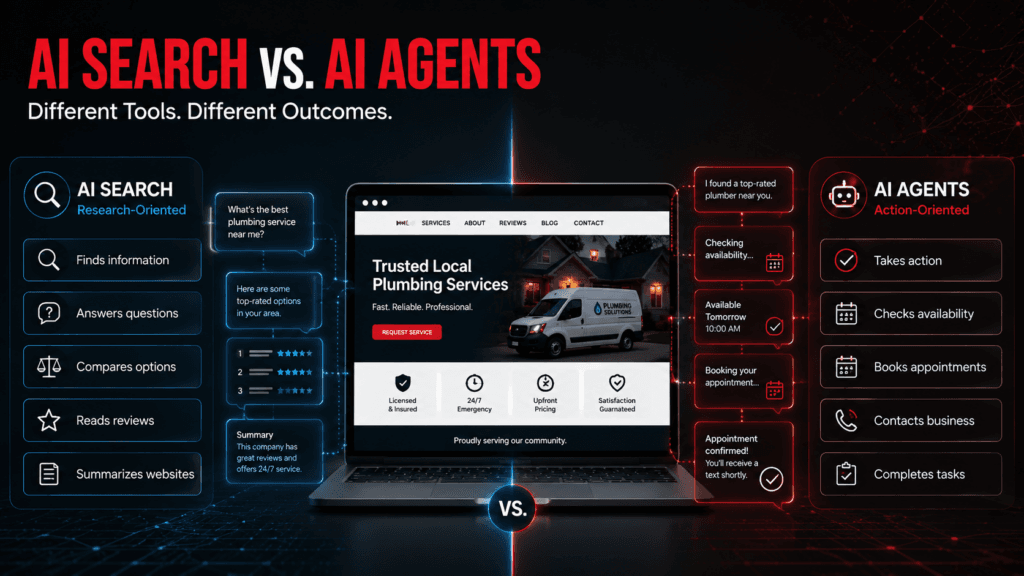
AI Search vs. AI Agents
There is an important distinction between AI visibility and AI-agent readiness.
| AI Search | AI Agents |
|---|---|
| Helps find information | Helps complete tasks |
| Answers questions | Takes supported actions |
| Recommends businesses | May interact with businesses |
| Summarizes information | May use information in a workflow |
| Primarily assists research | May assist with execution |
Think of AI search as an advanced research assistant.
Think of an AI agent as an assistant that may also be able to do something with the information it finds.
Both matter.
A business first has to be understood and considered. Eventually, it may also need to be easy for AI-assisted customers to interact with.
How Customer Searches Could Change
A traditional local search might look like this:
“Plumber near me.”
An AI-assisted request can be much more specific:
“Find a highly rated plumber within 10 miles who offers emergency service tonight, provides financing, and serves my neighborhood.”
Or someone looking for marketing help might ask:
“Find a WordPress web design company that specializes in Local SEO, offers ongoing website maintenance, serves North Texas businesses, and has strong customer reviews.”
That kind of request requires considerably more information than a traditional keyword search.
An AI assistant may need to determine:
- What services you provide
- Where you provide them
- How much they cost
- Whether pricing is available
- When you’re available
- How customers contact you
- Whether appointments can be booked online
- How experienced you are
- What customers say about you
- What credentials or qualifications you have
The more clearly your website answers those questions, the easier it is for both people and machines to understand what your business offers.
Your Website Still Matters in an AI-Driven World
One prediction we hear frequently is that AI will eventually eliminate the need for business websites.
That is unlikely to be the whole story.
AI systems still need information to work with, and a company’s own website remains one of the most important places a business can publish authoritative information about itself.
That includes:
- Services
- Locations
- Business hours
- Pricing guidance
- Policies
- Staff information
- Product information
- Project examples
- Frequently Asked Questions
- Booking options
- Contact information
Google’s current guidance for generative AI search continues to emphasize valuable, original content and says established SEO fundamentals remain relevant.
The role of the website therefore isn’t disappearing.
It may be evolving.
Instead of functioning primarily as an online brochure, your website can become a well-organized source of reliable information about your business that customers, search engines, and AI systems can all understand.
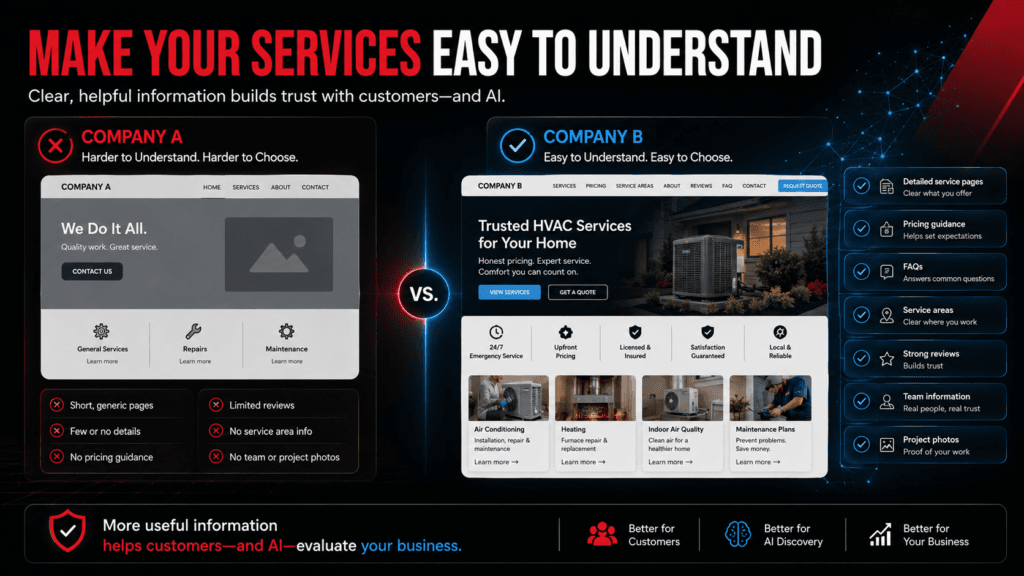
Make Your Services Easy to Understand
Imagine two HVAC companies.
Company A
- Five short, generic service pages
- Few customer reviews
- Little pricing information
- No FAQ section
- An outdated website
- Limited information about service areas
- Few examples of completed work
Company B
- Detailed individual service pages
- Helpful pricing explanations
- Strong customer reviews
- Educational articles
- Frequently Asked Questions
- Clearly defined service areas
- Fast, modern website
- Staff biographies
- Photos and examples of completed projects
- Easy-to-find contact and booking options
Company B provides considerably more information for a customer—or an AI assistant helping that customer—to evaluate.
That doesn’t guarantee an AI platform will recommend Company B.
AI recommendations can depend on many different sources and systems.
But Company B gives both people and machines far more useful information on which to base a decision.
Replace Generic Marketing Claims With Useful Information
Traditional business websites often rely heavily on promotional statements.
For example:
“We’re the best roofing company in Texas.”
That doesn’t provide much useful information.
A better website might explain:
“Most asphalt roof replacements take one to three days, depending on roof size, weather conditions, material availability, and whether structural repairs are required.”
Instead of simply saying:
“Affordable pricing.”
Explain:
“Project pricing depends primarily on the size of the job, materials selected, accessibility, and whether repairs are required before installation.”
Specific information helps customers make decisions.
It also gives search engines and AI systems clearer information about your services.
Your marketing copy should still communicate what makes your company different.
But specific expertise is usually more useful than unsupported superlatives.
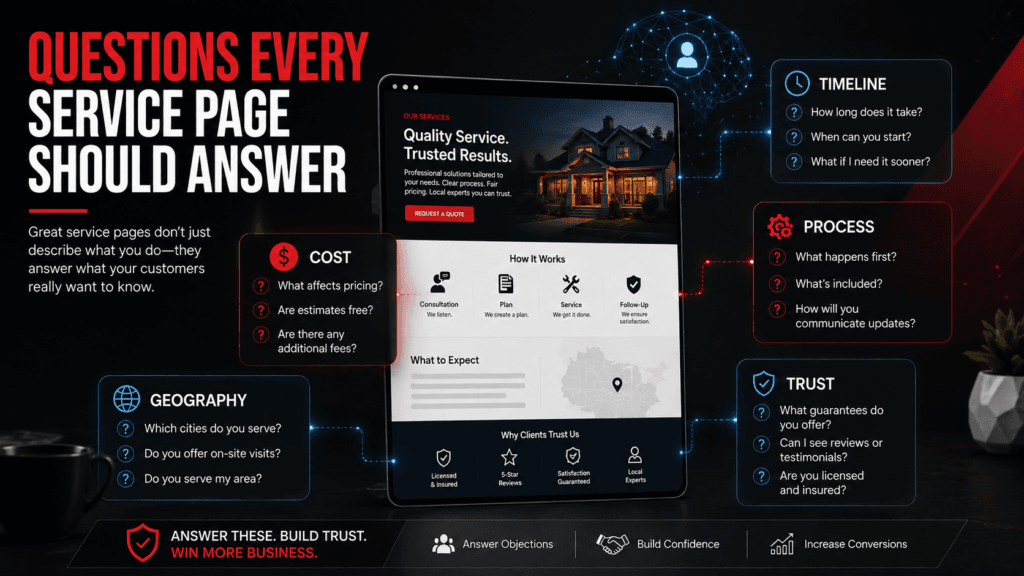
Questions Every Service Page Should Answer
Strong service pages should answer the questions prospective customers are likely to ask before contacting you.
Cost
- What affects the price?
- Are estimates free?
- Is there a typical price range?
- What is included?
Timeline
- How long does the service usually take?
- How quickly can customers get started?
- What could delay completion?
Process
- What happens after someone contacts you?
- What are the major steps?
- What should the customer prepare?
Common Problems
- What problems does this service solve?
- What warning signs should customers watch for?
- When should someone hire a professional?
Geography
- Which cities or neighborhoods do you serve?
- Are there geographic limitations?
- Are travel charges involved?
Trust
- How long have you been in business?
- What training or certifications do you have?
- Do you provide warranties or guarantees?
- Can visitors see examples of previous work?
Think of each service page as a resource that should help a visitor understand the service without having to hunt through the rest of your website for basic answers.
Structured Data Still Matters—But Don’t Overstate It
Structured data, commonly implemented using Schema.org markup, helps search engines understand certain information on webpages and can make pages eligible for specific search features.
Useful structured information can include things such as:
- Organization details
- Local business information
- Products
- Events
- Authors
- Articles
- Breadcrumbs
- Certain supported business information
However, structured data should not be treated as a secret AI optimization technique.
Google specifically says there is no special Schema.org markup required for its generative AI features, and structured data itself is not required to appear in those experiences. Google recommends continuing to use supported structured data correctly as part of an overall SEO strategy.
So the goal isn’t to add as much schema as possible.
The goal is to make sure the information on your website is accurate, consistent, understandable, and properly marked up where appropriate.
Make Your Website Easy to Navigate
Website organization becomes increasingly important when visitors—and automated systems—need to locate specific information quickly.
Instead of putting every service into one enormous page, many businesses benefit from dedicated pages for:
- Major services
- Important service areas
- Industries served
- Pricing information
- Frequently Asked Questions
- Case studies
- Customer success stories
- Team members
- Important policies
Clear navigation, descriptive page titles, logical internal linking, and well-organized content benefit everyone using the site.
That includes human visitors, search engines, accessibility tools, and increasingly sophisticated AI systems.
Build Content From Real Customer Questions
Some of the best content ideas don’t come from keyword tools.
They come from customers.
For a WordPress and Local SEO company, those questions might include:
- Why is my website slow?
- Do I really need WordPress maintenance?
- How much does Local SEO cost?
- How does AI search affect my business?
- Should I redesign my website or update the existing one?
- Why isn’t my business showing in Google’s local results?
If customers repeatedly ask a question during phone calls, emails, consultations, or sales meetings, there’s a good chance it deserves a page or article on your website.
This type of content also gives you something AI cannot easily manufacture on its own:
your actual experience helping customers solve real problems.
Google’s current AI-search guidance continues to emphasize useful, unique, non-commodity content rather than content created merely to manipulate visibility.
Reviews Provide Valuable Context
Customer reviews can communicate much more than a star rating.
Compare:
“Great company. Highly recommended.”
with:
“They redesigned our WordPress website, improved our Google Business Profile, and helped us generate more calls from customers in Plano and Frisco.”
The second review contains useful context about:
- Services provided
- Geographic area
- Customer experience
- Potential outcome
Businesses shouldn’t tell customers exactly what to write or encourage fabricated claims.
But you can ask customers to describe what service they received and what their experience was like.
Detailed, authentic reviews are more useful to prospective customers and provide additional context about what your company actually does.
Don’t Ignore Images
AI systems are increasingly capable of understanding visual content, but good image optimization was important long before AI.
Whenever possible, use:
- Original photography
- Images of actual projects
- Meaningful filenames
- Descriptive alternative text
- Relevant captions when appropriate
- Properly compressed image files
Instead of:
IMG_4812.jpg
a useful filename might be:
custom-kitchen-remodel-plano-texas.jpg
Alternative text should primarily describe the image for accessibility—not be treated as a place to stuff keywords.
Original photos also provide something generic stock photography can’t:
evidence of your actual people, work, products, locations, and experience.
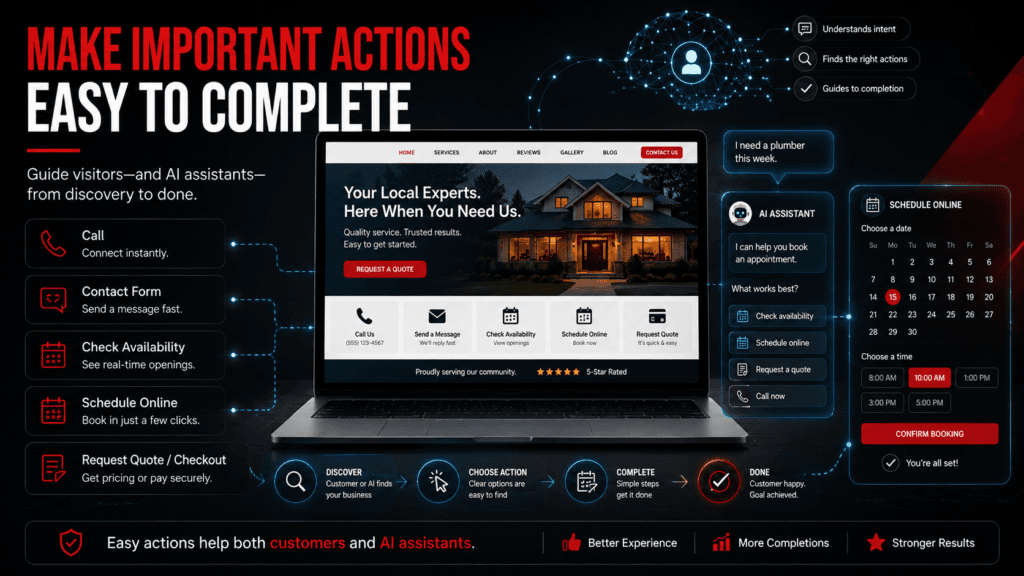
Make Important Actions Easy to Complete
This is where AI-agent readiness begins to differ from conventional SEO.
If a potential customer wants to take action, your website should make that process straightforward.
That may include:
- Clear contact forms
- Click-to-call phone numbers
- Online appointment scheduling
- Accurate store or office hours
- Up-to-date product availability
- Clear pricing or pricing guidance
- Accessible ecommerce functions
- Simple checkout processes
- Clearly labeled buttons and links
- Confirmation pages after forms or purchases
Browser-based AI systems often interact with webpages through many of the same visible controls people use. Microsoft, for example, says its browser Copilot can select elements, type information, and navigate pages directly.
That gives businesses another reason to avoid confusing navigation, broken forms, unnecessary popups, ambiguous buttons, and complicated booking processes.
A website that’s easier for an AI agent to use is usually also easier for a person to use.
APIs and the Future of Agent-Friendly Websites
This is one of the most interesting areas to watch.
Today, most small businesses don’t need to build custom APIs specifically for AI agents.
But the web is beginning to develop technologies designed to allow AI agents to interact with websites in more structured ways.
Google’s experimental WebMCP proposal, for example, would allow developers to expose website functionality—such as JavaScript functions and HTML forms—as structured tools that browser-based AI agents could use more reliably.
This could eventually make tasks such as booking, requesting information, checking availability, or interacting with online services easier for agents to complete without relying entirely on visually interpreting a webpage.
For most small businesses, there’s no reason to rush into experimental technology.
The practical approach today is simpler:
- Use modern, well-maintained website software
- Keep forms functioning properly
- Use reputable booking and ecommerce systems
- Maintain clean website architecture
- Keep business information accurate
- Avoid unnecessary technical barriers
- Make important customer actions obvious
If agent-specific standards become widely adopted, businesses with modern, well-maintained websites will generally be in a much better position to adapt.
Speed, Security and Accessibility Still Matter
AI does not eliminate traditional website fundamentals.
Your website should still be:
- Secure with HTTPS
- Mobile friendly
- Reasonably fast
- Accessible
- Easy to navigate
- Regularly maintained
- Free of broken links and forms
- Protected against malware and unauthorized access
These aren’t necessarily direct “AI ranking factors.”
They’re simply characteristics of a professional website that customers can reliably use.
And reliability will become even more important if customers increasingly delegate online tasks to AI assistants.
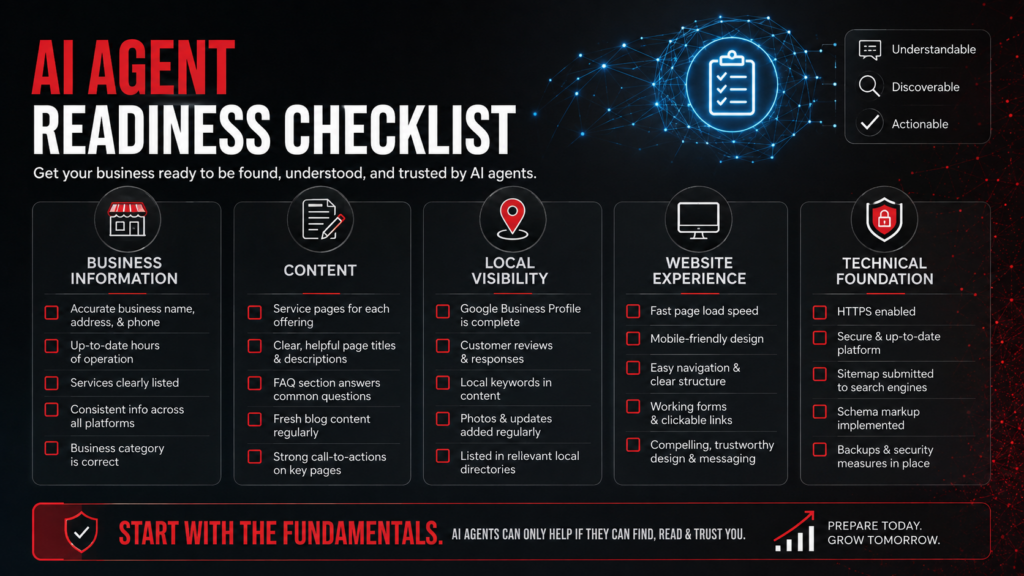
AI Agent Readiness Checklist
You don’t need to rebuild your website for AI agents.
Start with the fundamentals.
Business Information
- Business name, address, and phone information are accurate
- Business hours are current
- Service areas are clearly explained
- Services have dedicated, informative pages
- Contact methods are easy to find
- Pricing or pricing factors are explained when appropriate
Content
- Service pages answer common customer questions
- FAQs reflect actual customer questions
- Blog content demonstrates real expertise
- Case studies or project examples are available
- Team members and authors are identified
- Important information is kept current
Local Visibility
- Google Business Profile information is accurate
- Business information is consistent across important platforms
- Customer reviews are actively earned
- Important geographic service areas are clearly explained
Website Experience
- Website works well on mobile devices
- Navigation is straightforward
- Contact forms function correctly
- Booking or scheduling tools function correctly
- Buttons clearly describe what happens when clicked
- Important information isn’t hidden behind unnecessary barriers
Technical Foundation
- HTTPS is enabled
- Website performance is monitored
- XML sitemap is functioning
- Appropriate structured data is implemented correctly
- WordPress core, themes, and plugins are maintained
- Backups are functioning
- Website security is monitored
- Broken links and forms are periodically checked
The Evolution of Business Websites
The larger pattern is worth noticing.
The rise of AI doesn’t necessarily make the business website less important.
It changes what a good website needs to accomplish.
| Website Characteristic | Earlier Website | Today’s Website | AI-Ready Direction |
|---|---|---|---|
| Primary Goal | Online brochure | Generate leads | Provide trustworthy information and facilitate action |
| Homepage | Marketing focused | Marketing + education | Clear, useful and easy to navigate |
| Service Pages | Short descriptions | Detailed explanations | Comprehensive decision-making resources |
| SEO Strategy | Keywords | Search intent | Search intent + AI visibility + usability |
| Reviews | Helpful | Important | Important third-party context |
| Blog | Company news | SEO/content marketing | Demonstrates expertise and experience |
| Images | Decorative | Optimized | Original evidence of work and experience |
| Structured Data | Often overlooked | Recommended | Useful where appropriate, but not an AI shortcut |
| Website Actions | Contact form | Forms + scheduling | Clear, reliable, agent-friendly interactions |
| Maintenance | Occasional | Ongoing | Essential for reliability |
The goal isn’t to build a website for robots.
It’s to build a website that communicates your business so clearly that people, search engines, and AI-powered tools can all understand it.
Final Thoughts
The businesses that succeed in an AI-driven internet won’t necessarily be the ones using the most AI.
They’ll be businesses that make themselves easy to understand and easy to do business with.
That means:
- Publishing genuine expertise
- Keeping information accurate
- Clearly explaining services
- Answering real customer questions
- Maintaining a reliable website
- Building a strong reputation
- Making important actions easy to complete
AI agents are still evolving, and no business can know exactly how customers will interact with them several years from now.
You don’t need to chase every new AI technology.
Instead, build a strong foundation.
A website that is informative, trustworthy, accessible, well organized, and easy to use will serve your customers today while putting your business in a much stronger position for whatever comes next.
Is Your Website Ready for AI Agents?
Preparing your website for an AI-driven future doesn’t require rebuilding everything overnight.
It starts with making sure your website clearly explains who you are, what you do, where you work, why customers should trust you, and how someone can take the next step.
At TK Internet Marketing, we help North Texas small businesses improve WordPress websites, strengthen Local SEO, improve website performance, implement appropriate structured data, maintain website security, and create useful content designed for today’s changing search environment.
Want to know how prepared your website is for AI-powered search and AI agents?
Contact TK Internet Marketing for a website review and practical recommendations for strengthening your online presence.
